
14 Cow
Buy Quarter Beef Online: Your Practical Guide to 1/4 Cow Shares and Pricing
Buying a quarter beef is an easy way to stock your freezer with whole-animal cuts, lower your cost per pound, and cut down on weekly grocery runs. This guide walks you through what a 1/4 cow share typically includes, how hanging weight converts to the pounds you take home, how much freezer space you’ll need, and how to plan meals around the cuts you receive. Many buyers want clear numbers, storage tips, and a simple ordering path — that’s exactly what this article delivers, with practical examples and planning tools. You’ll also learn how breed and ranching choices affect flavor and nutrition, what to expect in a Corriente quarter share, and straightforward price-per-pound comparisons to retail. Below we cover definitions and weights, why we raise premium Corriente cattle with regenerative practices, a cut-by-cut breakdown for meal planning, transparent pricing math using a real product example, storage and thawing advice, and a concise FAQ on customization and household suitability.
What Is a Quarter Beef Share and How Much Meat Do You Get?
A quarter beef share is roughly one-fourth of a dressed carcass and, once processed, gives a reliable mix of steaks, roasts, ground beef, and bone-in pieces. The key difference in weights comes down to hanging weight — the carcass weight right off the rail — versus take-home weight after trimming, deboning, and moisture loss. That conversion is what lets you estimate usable pounds and roughly how many meals you’ll get, so you can plan freezer space and weekly menus without surprises. The next section breaks down hanging vs. take-home weight with clear numbers you can use.
How Is Hanging Weight Different from Take-Home Weight?
Hanging weight is the carcass measurement immediately after slaughter and initial dressing; take-home weight is what arrives at your freezer after processing, trimming, and portioning. Conversion rates typically fall between 55% and 70% of hanging weight, depending on whether cuts are bone-in or boneless, how aggressively meat is trimmed, and any moisture loss from aging. For example, a quarter with a 300 lb hanging weight might yield roughly 165–210 lb of packaged take-home meat — a practical range for meal and freezer planning. Always ask whether quoted pounds are hanging or take-home so you can plan accurately.
How Much Freezer Space Do You Need for a 1/4 Cow?
Freezer space depends on packaging density and whether cuts are bone-in or boneless. A good rule of thumb is 3 to 5 cubic feet for a typical quarter packaged in vacuum-sealed portions. Bone-in pieces take up more room per pound than ground or tightly-wrapped boneless packs; smart stacking and upright shelving can reduce the footprint. Label packages by date and cut, and group items by how often you use them to speed rotation. Use estimated take-home pounds plus your packaging choices to plan cubic feet and organize your freezer efficiently.
Why Choose Capital Farms’ Premium Corriente Quarter Beef?
Our premium Corriente quarter combines breed traits and deliberate ranch practices that shape flavor, leanness, and sourcing transparency. Corriente cattle are hardy and desert-adapted, producing a leaner profile and a flavor that differs from commercial continental breeds. When we pair that genetics with regenerative ranching — longer pasture time, careful grazing rotation, and extended finishing — it supports soil health, biodiversity, and animal welfare, and helps develop tenderness and flavor in finished cuts. We raise Corriente for 48+ months and finish on grain to promote consistent eating quality. The following sections explain Corriente advantages and how regenerative practices show up on your plate.
What Are the Benefits of Corriente Beef Compared to Other Breeds?
Corriente beef tends to be leaner with a pronounced, savory flavor because the breed matures and builds muscle differently than many commercial breeds. That profile delivers steaks and roasts that sear and braise well, with modest marbling that highlights beef’s natural flavor without heavy fat. Practically, Corriente gives you flexible cooking options: quick, high-heat sears for steaks and longer, low-and-slow methods for tougher cuts that still yield rich results. Knowing these breed characteristics helps you pick the best cooking method for each cut.
How Do Regenerative Ranching Practices Enhance Beef Quality?
Regenerative ranching — practices such as rotational grazing, building soil carbon, and managing herd density — improves forage quality and ecosystem resilience, and that influences animal nutrition and meat quality. Healthier soils grow more diverse, nutrient-rich forage, and animals grazing on that forage can develop more complex fatty-acid profiles and better overall condition. For buyers, these practices mean traceability, ethical sourcing, and a product story rooted in land stewardship rather than only price. At Capital Farms, regenerative care is central to how we raise Corriente beef and the eating attributes our customers enjoy.
What Cuts Are Included in a Quarter Beef Share?
A quarter beef share usually contains a balanced mix of steaks (ribeye, sirloin, strip), roasts (chuck, rump), a large amount of ground beef, and several bone-in pieces for stocks and slow cooking. That mix gives you quick-cook options and slow-cook staples to support weekly variety and batch-cooking. For meal planning it helps to see an itemized cut-by-cut list with typical weights and suggested uses — below is a concise table that translates pounds into practical meal planning guidance.
Each cut in a quarter share serves a culinary role, letting you split packages between immediate meals and long-term freezer stores.
| Cut Type | Typical Weight / Quantity | Use / Cooking Suggestion |
|---|---|---|
| Ribeye / Prime Steaks | 6–10 steaks (1.5–3 lb total) | High-heat sear or grill; serve fresh |
| Sirloin / Strip | 6–10 steaks (2–4 lb total) | Sear, grill, or pan-fry for weeknight meals |
| Chuck Roasts | 2–4 roasts (8–12 lb total) | Slow-cooker, braise, or pot roast |
| Ground Beef | 30–60 lb total (vacuum portions) | Burgers, tacos, sauces, batch meals |
| Bones & Short Ribs | Several packages (5–10 lb) | Stocks, braises, and soups |
Which Steaks, Roasts, and Ground Beef Are Provided?
A quarter share generally includes a mix of steak cuts (ribeye, strip, sirloin), several roasts (chuck, round, rump), and a large amount of ground beef — often the biggest volume by weight. That distribution comes from butchering yields and the processor’s cut sheet, which balances higher-value steaks with economical roasts and ground beef to give everyday versatility. Expect enough ground beef for many weekday meals, a handful of premium steak dinners, and several slow-roast meals for the family. Knowing typical poundages helps with recipe planning and stretching your grocery budget over weeks instead of days.
How Does the Cut Variety Support Meal Planning?
Cut variety helps you match cooking methods to your weekly schedule — steaks for weekend dinners, quick skillet meals midweek, and roasts or braises for batch cooking and leftovers. Tougher cuts shine with low-and-slow cooking, while ground beef is perfect for high-frequency templates like tacos, casseroles, and sauces. Practical tips: pre-portion ground beef into meal-sized packages, save a few premium steaks for special meals, and label everything clearly to reduce waste. With good rotation, a quarter share functions like a protein pantry that feeds your household for months.
How Much Does a Quarter Cow Cost and What Are the Savings?
Quarter prices vary by breed, processing choices, and ranch practices, but transparent math helps you compare price-per-pound to retail and see real savings. The cost advantage comes from buying direct and spreading overhead across a large volume, avoiding retail markups on both premium steaks and packaged ground beef. For example, Capital Farms lists a 1/4th Premium Corriente Beef product starting at $1,149.00 — a concrete figure you can use for price-per-pound calculations. The table below shows sample comparisons against typical retail benchmarks to highlight possible savings.
Seeing the numbers side-by-side makes it easier to decide whether bulk buying fits your budget and freezer capacity.
| Purchase Option | Price / Estimated $ per lb | Retail Comparison / Savings |
|---|---|---|
| 1/4th Premium Corriente Beef (example) | $1,149.00 / depends on take-home lbs | Often 20–40% less than comparable retail cost per usable pound |
| Typical Retail Mixed Cuts | $6–12 per lb | Higher per-pound cost for similar quality cuts |
| Ground Beef Bulk (retail) | $4–6 per lb | Bulk buy typically lowers this by $1–2 per lb |
How Does Buying a Quarter Beef Save Money Compared to Retail?

Buying a quarter saves money by lowering your effective price-per-pound across the whole protein basket — especially on ground beef and roasts that often carry larger retail markups. Using the Capital Farms example: if a quarter priced at $1,149.00 yields about 80 lb take-home, the cost works out to roughly $14.36 per usable pound before processing or transport — a figure that can be competitive with or below specialty retail for comparable quality. Factors such as processing fees, shipping, and trimming level will affect net savings, so include those in your comparison. Running these numbers helps you estimate cost per meal and pick the share size that best matches your consumption and savings goals.
What Are the Ordering and Delivery Options for Quarter Beef?
Ordering and delivery vary by farm but generally follow a simple process: pick a share size, choose processing preferences (bone-in vs boneless), confirm packaging, and schedule pickup or delivery. Expect a processing timeline that includes slaughter, aging, cutting, and packaging before pickup, and most farms arrange deliveries or pickups by appointment. Many farms offer limited customization and may charge extra for custom cut sheets or special packaging. Ask about processing timelines, pickup windows, and any additional fees up front to avoid surprises and to line up freezer space ahead of delivery.
How Should You Store and Use Your Quarter Beef Share?
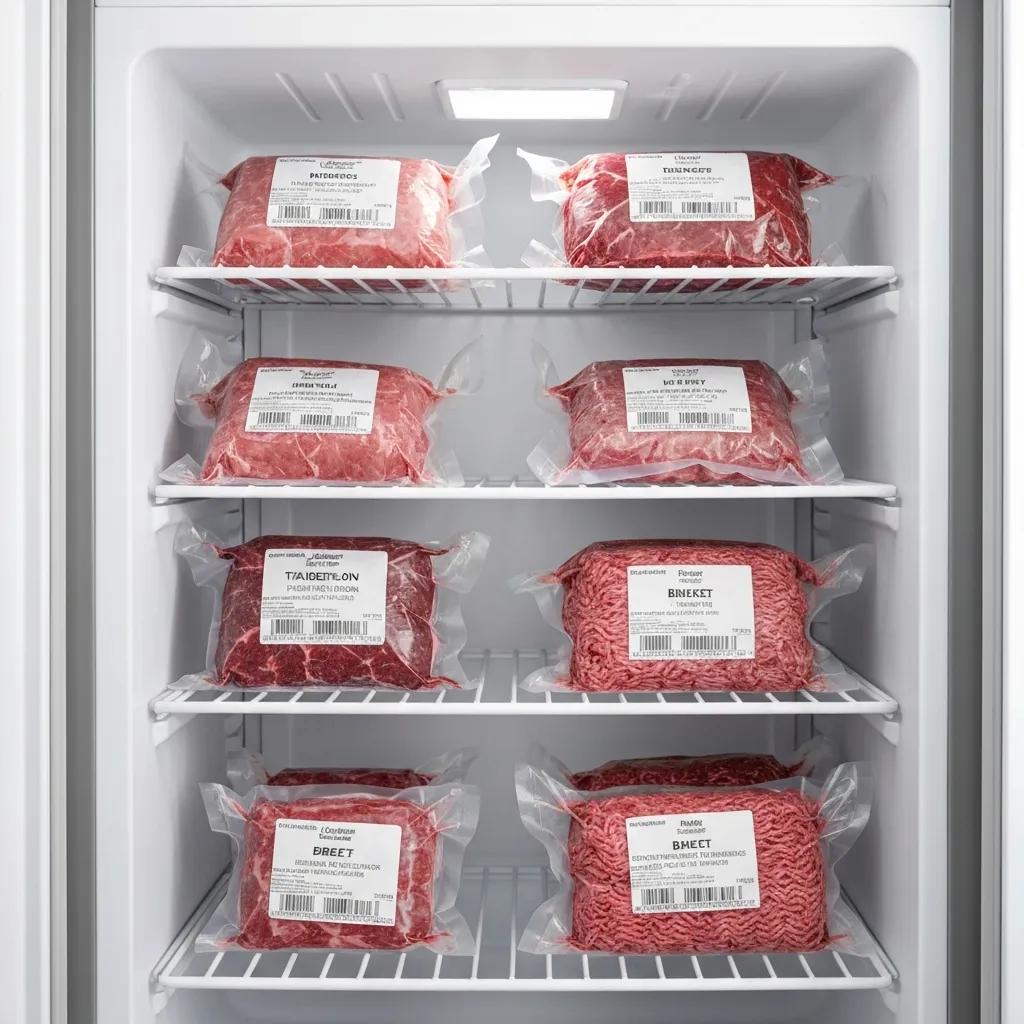
Good storage preserves flavor and safety while maximizing shelf life and freezer efficiency. Barrier packaging and steady sub-zero temperatures prevent freezer burn and oxidation — vacuum sealing is the most effective approach for long-term storage. Label packs with cut and date and rotate by use frequency. The table below summarizes storage methods, expected freezer space, and recommended thawing timelines so you can access cuts easily and keep them tasting their best.
Follow these practices and each cut will perform well at cooking time while minimizing waste and making weekly meal planning easier.
| Storage Method | Expected Freezer Space / Packaging | Recommended Time / Thawing Method |
|---|---|---|
| Vacuum-sealed portions | High density; reduces cubic feet per lb | 6–12 months; thaw in refrigerator 24–48 hours |
| Resealable freezer bags (double-wrapped) | Moderate space; more bulky | 3–6 months; cold-water thaw for faster use |
| Large bone-in roasts (wrapped) | Bulky; requires more cubic feet | 6–12 months; thaw in fridge 48+ hours |
What Are the Best Practices for Freezing and Thawing Bulk Beef?
Vacuum sealing prevents freezer burn and keeps quality high; portioning into meal-sized packs saves time and avoids repeated thawing. Store beef at 0°F (-18°C) or lower and label each package with cut, weight, and pack date to make rotation simple. For large cuts, thaw in the refrigerator; for faster needs, sealed cold-water thawing is acceptable. Never thaw at room temperature. Following these steps reduces waste and delivers consistent cooking results across steaks, roasts, and ground beef.
What Recipes Work Best for Different Quarter Beef Cuts?
Match quick, high-heat methods to premium steaks, use slow-roasts and braises for tougher chuck and round cuts, and turn ground beef into sauces, chilis, or portioned patties for meal prep. For steaks, a simple salt-and-pepper sear and a short rest highlight flavor; for chuck roasts, braising or slow-cooker recipes make tender, crowd-pleasing meals. Ground beef is ideal for batch cooking that freezes and reheats well. Start by using premium cuts early in the rotation and reserve tougher cuts for batch cooking to maximize value and variety.
What Are the Most Common Questions About Buying a Quarter Cow?
Common questions include whether a quarter cow makes sense for a given household, how much customization is possible, and how freezer space and processing fees affect total value. These matter because a quarter share is both a financial and logistical decision: matching share size to consumption patterns avoids waste and maximizes savings. Thinking through simple rules and examples will help you choose between 1/8, 1/4, 1/2, or whole shares based on freezer capacity and how often you cook. The next sections address household suitability and typical customization options so you can make an informed choice.
Is Buying a Quarter Cow Worth It for Families and Individuals?
A quarter cow is a great fit for many families and for couples who cook regularly and have freezer space — it provides enough variety and volume to cover meals for months. Single households or infrequent cooks may prefer a 1/8 share or splitting a quarter with another household to avoid long-term storage and repeated thaw cycles. Consider weekly consumption, freezer cubic feet, and whether you want to manage bulk portioning; these practical points determine whether the per-pound savings outweigh the storage and processing responsibilities. A quick calculation of weekly meat use will help you choose the most cost-effective share size.
Can You Customize Your Quarter Beef Share?
Customization often includes choosing boneless versus bone-in processing, specifying steak counts, or adjusting ground-beef amounts, but options depend on the farm’s processing partner and cut-sheet policies. Many farms allow reasonable swaps within the standard cut sheet — for example, more roasts instead of some steaks — though extensive changes can add processing time or fees. Communicate your preferences early so the processor can accommodate them and so you can plan packaging and pickup. Knowing likely limits up front avoids disappointment and clarifies any extra costs.
Ready to buy? Capital Farms currently lists a 1/4th Premium Corriente Beef product priced at $1,149.00 as a clear example of an available option. That price gives you a starting point to run price-per-pound math against your estimated take-home weight and decide if a share fits your budget and freezer plan.
Next steps: review available share sizes and processing choices, confirm estimated take-home pounds, and plan freezer or split-share logistics before placing an order. The paragraph below points you toward the product offering and a clear call to action for buyers ready to move forward.
Capital Farms offers the 1/4th Premium Corriente Beef share for buyers who want traceable, regenerative-raised beef with clear breed and finishing practices; use the listed product price to calculate household cost and savings before ordering.
Frequently Asked Questions
What is the best way to prepare different cuts of beef from a quarter share?
Match cooking methods to the cut. Premium steaks like ribeye and sirloin shine with high-heat grilling or pan-searing and a short rest. Tougher cuts such as chuck roasts do best slow-braised or in a slow cooker until fork-tender. Ground beef is extremely versatile — think tacos, meat sauces, chili, or portioned burger patties. Choosing the right technique brings out the best texture and flavor from each cut.
How can I ensure the quality of my quarter beef share during storage?
Store packages at a steady 0°F (-18°C) or lower and vacuum-seal when possible to prevent freezer burn and preserve flavor. Label each package with the cut and pack date and rotate older items to the front. Thaw in the refrigerator for safety; use sealed cold-water thawing when you need food faster. These habits keep your beef tasting fresh for months.
What are the environmental benefits of choosing regenerative ranching practices?
Regenerative ranching supports soil health, biodiversity, and improved forage through practices like rotational grazing and building soil carbon. Healthier soils produce more nutrient-dense forage, which benefits animal nutrition and can influence meat quality. By choosing beef raised with these methods, consumers support a more sustainable food system focused on land stewardship and ethical sourcing.
How do I calculate the cost savings when buying a quarter cow?
Compare the bulk purchase price per usable pound to comparable retail prices. For example, if a quarter costs $1,149.00 and yields about 80 lb of take-home meat, the effective cost is roughly $14.36 per usable pound. Retail prices for similar quality cuts often run $6–$12 per pound, so bulk buying can translate to 20–40% savings, depending on processing fees and transport. Run the numbers with your estimated take-home weight to see actual savings.
What should I consider when deciding on the size of my beef share?
Think about household meat consumption, freezer capacity, and how often you cook. A quarter share suits families and frequent cooks, while smaller households may prefer an eighth or a split quarter. Estimate weekly meat use and how much variety you want; that will guide you to a share size that minimizes waste and maximizes value.
Are there any specific health benefits associated with Corriente beef?
Corriente beef is often leaner and features a distinct flavor influenced by breed genetics and ranching practices. Animals raised on diverse forage and regenerative systems may develop more varied fatty-acid profiles and benefit from better overall nutrition. Choosing Corriente from regenerative systems can therefore offer a leaner option with a strong flavor profile and a farming story tied to animal and land health.
Conclusion
Buying a quarter beef share is a practical way to save money and keep high-quality, varied cuts on hand. Choosing premium Corriente raised with regenerative practices gives you traceability, thoughtful ranching, and a distinct eating experience. Know your processing options, confirm estimated take-home pounds, and plan freezer space to ensure a smooth farm-to-table transition. Explore our offerings today to find the share size that fits your household and makes weekly meals easier and more delicious.