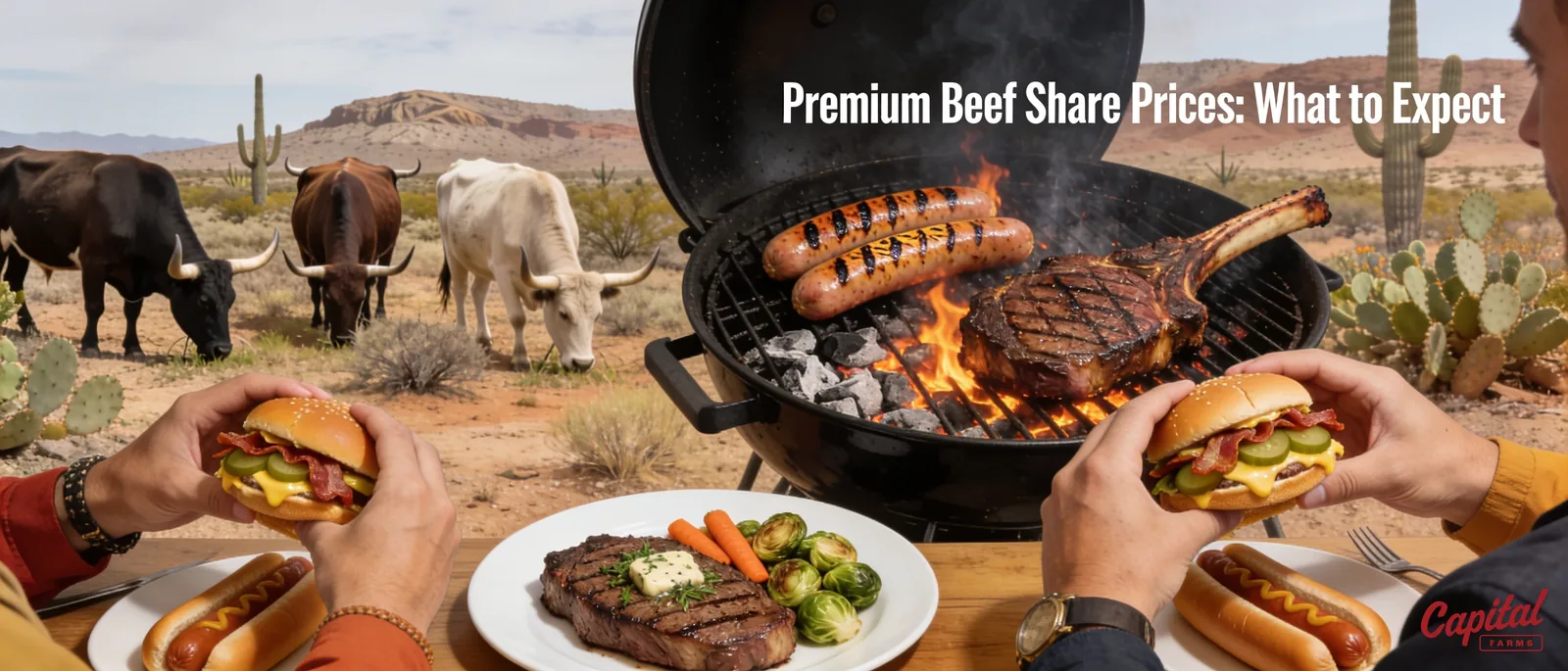
Premium Beef Share Prices: What to Expect
Premium Beef Share Prices: What to Expect
By Capital Farms Meats & Provisions Editorial Team · Updated 2026-07-28
Pricing at Capital Farms Meats & Provisions reflects cut and quantity: NY Strip Steak starts at $23.00, Sirloin Steak at $22.00, and Premium Corriente Beef Tallow ranges from $11.99 for a 14 oz jar to $79.99 for a 1-gallon bucket, with free shipping on orders over $250.
Pricing breakdown includes individual cut costs such as Capital Farms' NY Strip Steak starting at $23.00. Sirloin Steak starting at $22.00, plus added-value items like Premium Corriente Beef Tallow (14 oz Jar, $11.99), with free shipping available on orders exceeding $250 to select states.
Premium beef share pricing covers three components: the live animal weight, processing fees, and packaging into freezer-ready cuts. Capital Farms sources Corriente cattle raised near Wickenburg, AZ. Capital Farms' beef is grass-fed and 200-day grain-finished, reflecting the extended 48-month maturation behind the total cost of quarter, half, and whole shares.
Key Takeaways
- Premium beef shares include butchering, packaging, and processing fees beyond the animal cost itself.
- Capital Farms offers NY Strip Steaks starting at $23.00 and Sirloin Steaks from $22.00.
- Beef share pricing breaks down into per-pound costs for various cuts like steaks and ground beef.
- Free shipping applies to orders over $250 across ten western and central US states.
What drives premium beef share pricing?
Premium beef share prices reflect a fundamentally different purchase than a grocery-store cut. A beef share means buying a portion of a whole animal directly from a producer, and that structure changes how costs get calculated from the ground up. Grocery pricing covers a single package; share pricing covers raising, feeding, and processing an entire animal, split among buyers.
Several factors shape the final number on a beef share invoice:
- Feeding program length — extended grass-fed and grain-finished periods raise input costs but improve flavor and marbling.
- Hormone-free standards — raising cattle without growth hormones takes more time and resources.
- Industry pricing models — some producers reference grid pricing, where a base price adjusts up or down based on quality factors, while others use formula pricing tied to an external reference price.
Why does Capital Farms' beef cost more than store-bought beef?
Capital Farms' beef carries a premium tied directly to its production standard. Cattle follow a grass-fed diet, then a 200-day grain-finishing period, without hormones added at any stage. That extended timeline costs more to produce. It delivers deeper flavor and consistent quality that fast-finished, grocery-shelf beef rarely matches.
What is actually included in the total price?
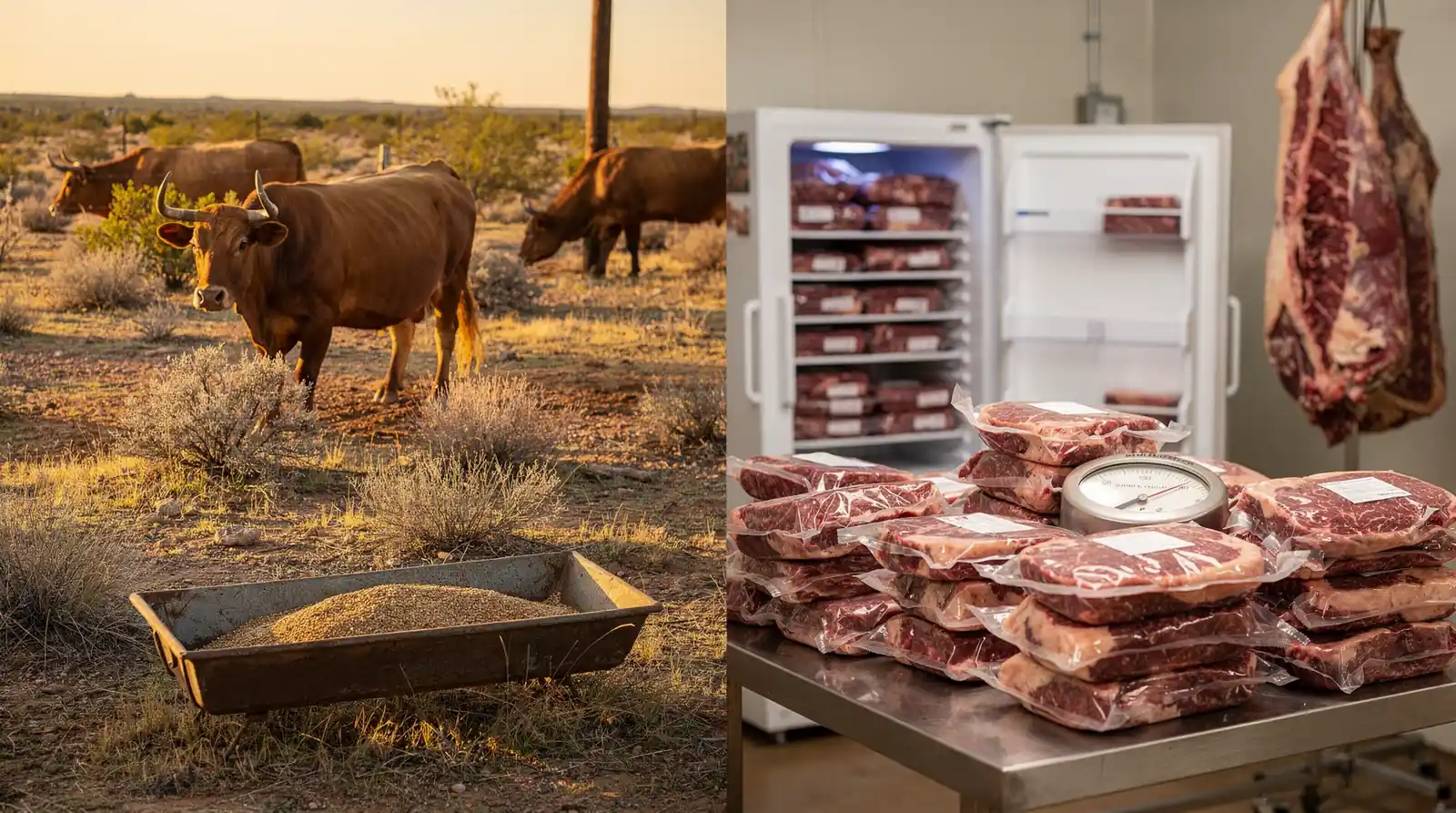
Premium beef share prices cover far more than the meat sitting in a freezer. Buyers pay for the live animal, the butchering labor, the vacuum-sealed packaging, and the security of a year's worth of beef stocked away. Skipping any of these steps isn't an option; each one determines whether the beef arrives safe, clean, and ready to cook.
Why does hanging weight differ from what actually goes home?
Hanging weight, sometimes called dressed weight, reflects the animal right after harvest, before butchering begins. That figure still includes bones, organs, and other material nobody eats. Take-home weight tells a different story: it's the trimmed, de-boned, packaged beef that actually lands in the freezer, and it typically runs around 65% of hanging weight. Buyers who compare prices without accounting for that gap often underestimate their real cost per pound.
Two more line items round out the true total:
- Shipping fees — Capital Farms waives shipping only on orders above pricing varies and only to a defined group of states including Arizona, California, Nevada, Utah, and Texas among others.
- Byproducts — items like beef tallow, sold separately in bucket form, add to the overall spend depending on package size.
Factoring in all four pieces gives a far more accurate picture than the sticker price alone.
What should buyers expect to budget per cut?
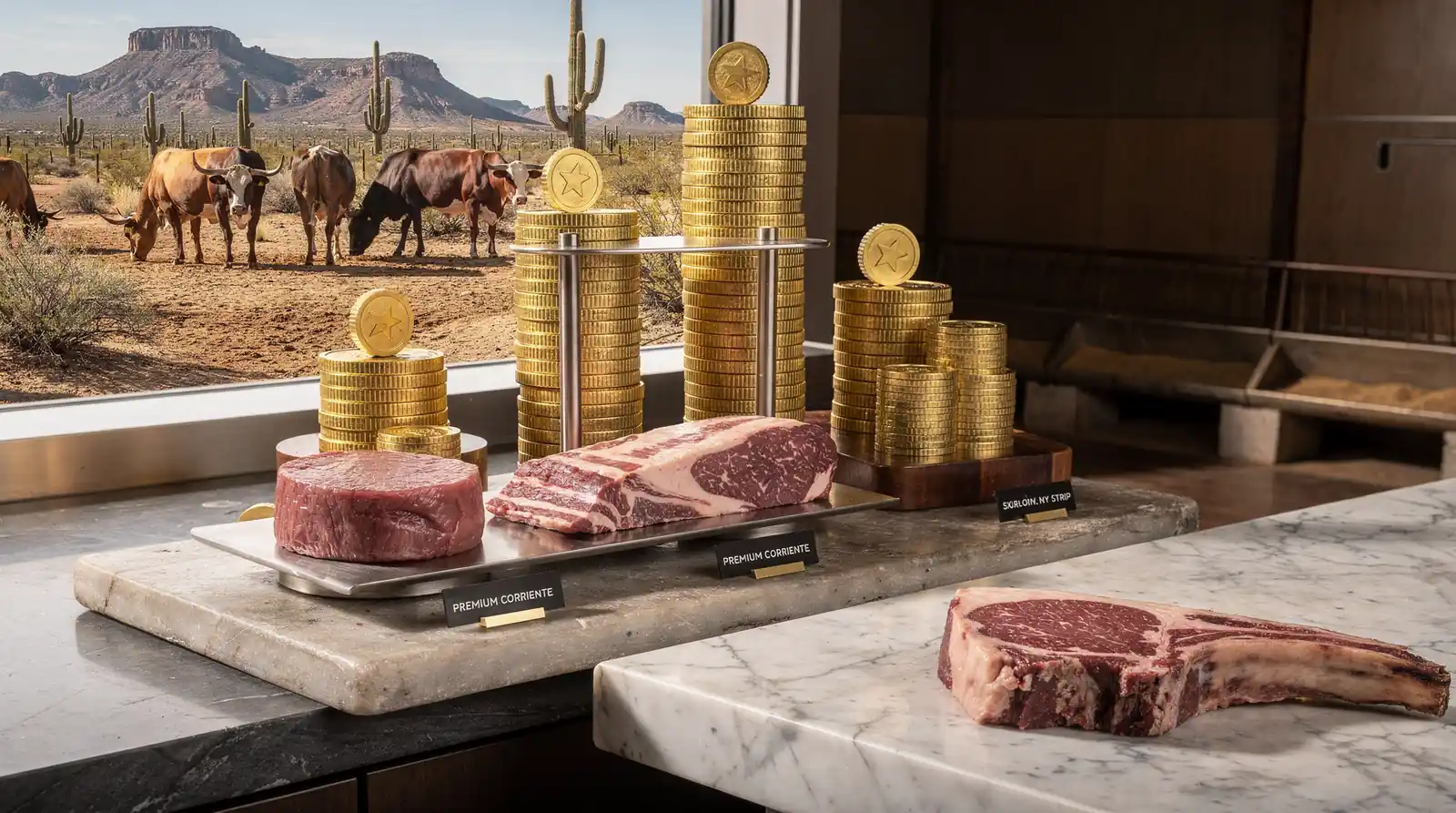
Cut-by-cut pricing at Capital Farms ranges from $14.00 to $53.00, depending on the cut's tenderness and marbling. Filet Mignon Steak sits at the top of the range, starting at $53.00, a reflection of its exceptional tenderness. Ribeye Steak follows at $31.00, priced higher than sirloin or NY strip because of its dense marbling. Buyers weighing premium beef share prices across a full order should expect this kind of tiered structure rather than a apartment rate.
| Cut | Starting Price |
|---|---|
| Filet Mignon Steak | $53.00 |
| Ribeye Steak | $31.00 |
| NY Strip Steak | $23.00 |
| Teres Major Steak | $14.00 |
NY Strip and Sirloin land in a comparable mid-range bracket, giving households an accessible way into premium beef without committing to the filet price point. Teres Major, by contrast, offers one of the lowest entry prices among premium cuts. Meal-prep families often lean on this cut to stretch a beef share budget further.
Are these prices worth it compared to grocery store beef?
Capital Farms holds a 4.9-star average across 3.4K customer reviews, a strong signal that the pricing matches perceived quality. Households comparing costs against grocery store beef often find the difference justified once tenderness and consistency enter the equation.
Which cut gives the best value for a first-time buyer?
Teres Major offers the lowest starting price and works well for buyers testing quality before committing to pricier cuts. NY Strip and Sirloin provide a reasonable middle step for those ready to spend a bit more.
Investing in a premium beef share from Capital Farms represents a commitment to quality, sustainability, and authentic flavor. Our pricing reflects the rigorous standards we maintain throughout every stage of production—from our Corriente cattle's extended grazing period to our careful grain-finishing process. When you choose Capital Farms, you receive beef that honors both ranching tradition and modern excellence, backed by our dedication to transparency and uncompromising quality standards.
FAQ
What does a premium beef share price actually cover?
A beef share price covers the live animal, butchering labor, vacuum-sealed packaging, and a year's worth of stocked beef. It reflects raising, feeding, and processing an entire animal split among buyers, not a single grocery package.
Why does take-home weight differ from hanging weight?
Hanging weight includes bones, organs, and other inedible material right after harvest. Take-home weight is the trimmed, de-boned, packaged beef that lands in the freezer, typically running around 65% of hanging weight.
Does shipping affect the total beef share cost?
Yes, shipping fees factor into the total unless the order exceeds $250 and ships to select states, including Arizona, California, Nevada, Utah, and Texas. Orders below that threshold or outside those states incur shipping charges.