
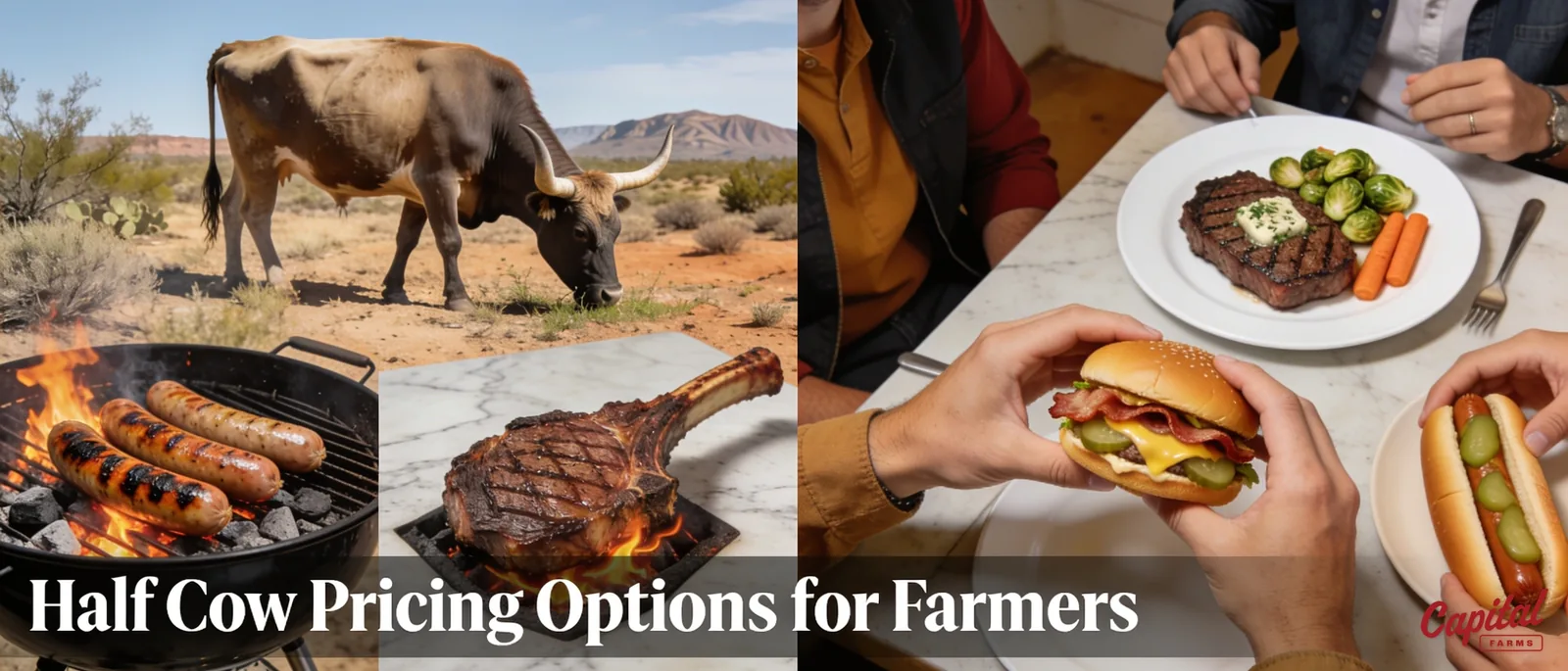
Half Cow Pricing Options for Farmers
Half Cow Pricing Options for Farmers
By Capital Farms Meats & Provisions Editorial Team · Updated 2026-07-28
Capital Farms Meats & Provisions prices premium Corriente half cow shares by cut selection, with individual items like NY Strip Steak starting at $23.00 and Sirloin Steak at $22.00, plus shipping on orders over $250 across 13 states including Arizona and Texas.
Half Cow Options: Farmers typically price whole-animal purchases based on hanging weight, yielding 149 pounds of take-home beef for a price that varies, requiring 7 to 9 cubic feet of freezer space. Capital Farms complements this model with premium à la carte cuts like NY Strip Steak from $23.00 and Sirloin from $22.00.
Half-cow pricing models for premium beef programs typically combine a apartment hanging-weight rate with processing fees, reflecting that Capitalfarms.Com beef is grass-fed and 200-day grain-finished. Farmers building similar direct-to-consumer programs should base pricing on breed genetics, feeding duration, and hormone-free grass-fed practices rather than commodity market averages, protecting margins while justifying premium positioning to customers.
Key Takeaways
Capital Farms Meats & Provisions in Wickenburg, Arizona offers premium Corriente beef half cow options.
Half cow purchases eliminate retail markup costs, delivering significant long-term savings on quality beef.
NY Strip Steaks start at $23.00 and Sirloin Steaks at $22.00 per cut.
Shipping applies to orders exceeding $250 across eight western and central US states.
What Drives Half Cow Pricing Options Today?
Breed, feed program, and finished animal size set the baseline for [half cow](https://capitalfarms.com/products/1-2-of-premium-corriente-beef) pricing options, and no two ranches land on the same number. A half cow typically yields 149 pounds of take-home beef, with meat costs that vary by farm before processing fees enter the picture. That spread exists for a reason: buyers are paying for time, land, and genetics, not a commodity cut.
Feed timeline matters most for ranchers building a defensible price. Capital Farms' program grazes cattle on Wickenburg, Arizona rangeland for two years before finishing on grain for 200 days. Desert forage conditions and that extended finishing window raise input costs well above a standard 18-month program. Pricing should reflect it.
Why does half cow pricing vary so much between farms?
Feed, breed, and size are the three biggest swing factors. A grass-fed, grain-finished operation with a longer timeline carries different overhead than a fast-finished commercial herd, and that difference belongs in the price tag.
Cost drivers to factor into a per-pound price:
Breed and marbling characteristics
Length of grass and grain feeding periods
Finished carcass weight
Regional feed and rangeland costs
Processing and packaging fees separate from meat cost
How Do Cuts and Yield Change Your Price?
Cut composition and total yield drive the final number on any half-cow invoice more than any other factor. A farmer setting half cow pricing options should treat the packing sheet, not the hanging weight alone, as the real pricing document. Two customers buying the same live weight can end up with very different value in the freezer.
Why do premium cuts change the math?
High-value cuts pull the average price per pound upward, and that matters when structuring a share. Ribeye Steak, priced from $31.00, sits near the top of the retail comparison scale. Filet Mignon Steak, starting at $53.00, represents the ceiling most farmers reference when justifying a premium tier. NY Strip Steak, from $23.00, fills the mid-range and helps anchor a fair, defensible blended rate across the whole animal.
What about freezer space and farming method?
Buyers need to plan for 7 to 9 cubic feet of freezer space per half cow before processing fees even enter the conversation. That space requirement is a real cost, and farmers should mention it upfront. Pasture-raised, grain-finished beef also justifies a stronger price point. It pairs responsible farming with the marbling and tenderness customers expect from a premium share.
Why Does Longer-Finished Beef Command More?
Time in the pasture and feedlot builds flavor that shapes half cow pricing options for years to come. Corriente cattle that are grass-fed and 200-day grain-finished develop a depth of flavor. A buttery, tender texture that younger, fast-finished cattle simply never reach. That extended timeline costs more to manage, and it justifies a higher price point on every share sold.
Credentials matter just as much as age. Beef that carries hormone-free, grass-fed, and grain-finished labeling gives buyers a reason to pay above commodity rates. Ranchers building premium programs should treat these three claims as pricing leverage, not marketing decoration. Farmers can review a full buying guide for a deeper breakdown of cost, cuts, and convenience before setting a final rate.
Does trust actually affect what buyers will pay?
Trust changes the ceiling on price. Programs that maintain consistent quality can earn the kind of loyalty reflected in strong customer reviews and high satisfaction scores. A track record like that becomes part of the value proposition, right alongside the meat itself.
Guarantees reinforce that trust further. Standing behind an order with a replacement or full refund removes risk for the buyer and supports a premium price for the seller. Consider stacking these credentials:
Extended maturation age
Hormone-free, grass-fed, grain-finished status
A visible satisfaction guarantee
A demonstrated history of positive reviews
Ranchers expanding into new markets can also learn how regional demand shapes pricing by studying a regional guide built around a specific local buyer base.
Capital Farms remains committed to delivering premium Corriente beef that reflects our dedication to quality, sustainability, and agricultural tradition. For farmers and beef enthusiasts seeking half cow options, our sourcing practices and rigorous quality standards ensure a product worthy of your investment. We invite you to experience the difference that proper breeding, careful stewardship, and time-honored finishing methods bring to every cut.
FAQ
How much does a half cow typically cost?
A half cow yields 149 pounds of take-home beef, with meat costs that vary by farm before processing fees, based on hanging weight.
What factors cause half cow prices to vary between farms?
Breed and marbling, length of grass and grain feeding periods, finished carcass weight, regional feed costs, and processing fees all shift the final per-pound price.
How much freezer space does a half cow require?
Buyers need 7 to 9 cubic feet of freezer space to store the 149 pounds of beef a half cow typically yields.