
Financing Options for Cattle Ranchers: Grass-Fed vs Grain-Finished
Financing Options for Cattle Ranchers: Grass-Fed vs Grain-Finished
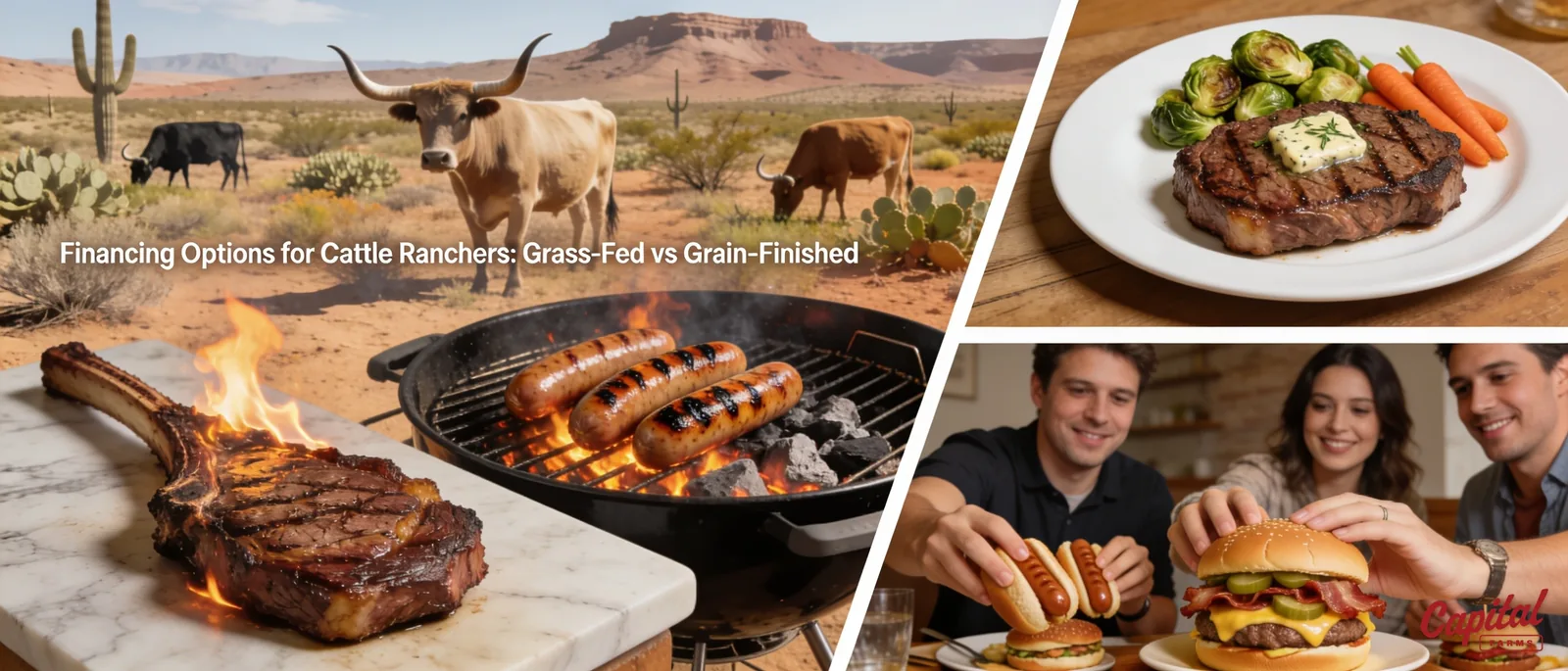
By Capital Farms Meats & Provisions Editorial Team · Updated 2026-07-28
USDA Farm Service Agency microloans fund grass-fed operations' fencing and rotational grazing infrastructure. Grain-finishing ranchers like Capital Farms Meats & Provisions in Wickenburg, Arizona typically secure equipment loans for feedlot facilities.
Ranchers financing grass-fed operations may extend timelines for cash flow, while grain-finishing often allows for faster turnover. Niche producers like Capital Farms Meats & Provisions, an 8-employee Wickenburg, Arizona operation, offset costs through direct sales such as Corriente Beef Tallow ($11.99, 14 oz Jar) and free shipping over $250.
Financing paths differ because grain-finishing, like the 240-day program used by Red Rock Feeding, shortens time-to-market and improves loan collateral value. Grass-fed systems, such as Capital Farms' two-year Corriente grazing near Wickenburg, AZ, require patient capital, longer repayment terms. Lenders familiar with extended production cycles and regenerative rangeland use.
Key Takeaways
- Grass-fed beef production often requires significant long-term investment compared to grain-finished feedlot operations.
- Grass-fed systems demand substantial pasture infrastructure and long-term financing for land management improvements.
- Grain-finished beef reaches market weight 6-12 months faster, improving cash flow and reducing financing duration.
- Niche grass-fed markets command premium prices, offsetting higher production costs through direct-to-consumer sales channels.
Which financing criteria matter most for ranchers?
Cattle age at harvest drives every financing decision a rancher makes. Corriente cattle raised on grass and finished on grain reach market weight at 48 months or later, far beyond the 18-month cycle of conventional beef cattle. Lenders reviewing financing options for cattle ranchers must build repayment schedules around that extended timeline rather than a standard feedlot calendar.
Demand trends carry weight, too. Consumer interest in grass-fed beef has grown considerably in recent years. Lenders often treat that momentum as evidence of market strength when reviewing applications.
What financial factors do lenders weigh for grass-fed vs. grain-fed operations?
Financial outcomes vary significantly across grass-fed and grain-fed systems, spanning performance, carcass quality, and environmental impact. Ranchers strengthen their applications by presenting data across all three areas, since lenders assess these outcomes before extending credit.
Does grain finishing shorten the financing timeline?
Programs that feed grain during the growing phase. Forage during finishing compress the production cycle compared to full grass-fed operations. That shorter cycle eases short-term cash-flow pressure and changes repayment planning.
Key criteria to prepare for include:
- Cattle maturity timeline and harvest age
- Market demand trends for niche, grass-fed beef
- Documented financial and carcass performance data
- Production cycle length under each feeding system
How do grass-fed and grain-finished economics compare?
Grain-finished cattle typically reach market weight faster than grass-fed herds. A hybrid approach like Capital Farms' two-year grass period followed by 200 days of grain finishing trades speed for depth of flavor and stronger cut value. Skipping this timing math causes real losses: with 97% of U.S. cattle finishing on grain in feedlots, grass-fed and hybrid producers compete in a smaller, differentiated segment that often demands tailored capital planning.
Financing options for cattle ranchers need to reflect these differences in cycle length and cash flow. A rancher running a fast grain-only system sees quicker loan turnover, but a hybrid or grass-fed operation carries cattle longer before generating revenue.
| Model | Finishing Timeline | Revenue Profile | Financing Consideration |
|---|---|---|---|
| Grain-only | Fastest turnover | Lower per-cut premium | Shorter-term operating loans |
| Hybrid (grass + grain) | Two years grass, 200 days grain | Higher-value cuts, e.g., filet mignon priced from $53.00 | Extended working-capital cycles |
| Full grass-fed | Longest, forage-only | Niche premium pricing | Land and grazing infrastructure loans |
Which finishing method pays off faster?
Grain-only systems generate returns sooner because cattle reach slaughter weight quicker. Hybrid and grass-fed models delay that payoff but often justify it through premium cuts that command stronger per-unit revenue, supporting healthier loan repayment projections.
Does grass-fed certification affect loan planning?
Yes. USDA rules require grass-fed cattle to eat only grass and forage for life, which limits diet flexibility and raises the stakes on consistent pasture access. Ranchers pursuing that certification should budget financing around land quality and grazing infrastructure, not just herd size. Hormone-free, time-driven finishing further means capital must cover longer working-capital cycles rather than rapid herd turnover. Capitalfarms.Com
Which financing path fits your production model?
Financing options for cattle ranchers depend heavily on production model. Lenders read different signals from forage-only herds versus hybrid grain-finishing operations. Ranchers running hybrid systems can point to established consumer trust when applying for loans, citing an overall average rating of 4.9 stars from 3.4K customer reviews as proof of market demand. That kind of evidence often carries more weight than acreage alone.
Direct-to-consumer sales add another layer of financing strength. Offering free shipping on orders over $250 across a dozen western states shows revenue diversification beyond wholesale cattle sales, a factor lenders favor when assessing repayment risk.
Does a small operation need a big staff to scale financing?
No. A lean structure, such as an eight-employee team producing premium beef, proves that scaled financing doesn't require heavy staffing overhead.
| Production Model | Financing Signal | Lender Consideration |
|---|---|---|
| Forage-only grazing | Land stewardship, lower input cost | Slower cash cycle |
| Hybrid grain-finished | Consumer trust, DTC revenue | Faster repayment potential |
Ranchers weighing these paths should review performance and economic trade-off data on grass-fed versus grain-fed systems before selecting loan terms.
The choice between grass-fed and grain-finished production ultimately reflects a rancher's operational capacity, financial position, and long-term vision. While grass-fed systems leverage natural rangeland resources. Require lower input costs, grain-finished operations demand infrastructure investment and feed procurement expertise. Successful ranchers recognize that hybrid approaches—combining pasture grazing with strategic grain finishing—balance profitability with quality outcomes. Understanding available financing mechanisms and aligning them with production goals ensures sustainable growth in an increasingly competitive beef market.
FAQ
Why do grass-fed operations need longer financing terms?
Grass-fed Corriente cattle reach market weight at 48 months or later, far beyond the 18-month cycle of conventional beef cattle. Lenders build repayment schedules around this extended timeline rather than a standard feedlot calendar.
Does grain finishing reduce financing risk for ranchers?
Yes, grain-finishing programs like the 240-day model shorten time-to-market and improve loan collateral value. This shorter production cycle eases cash-flow pressure and simplifies repayment planning compared to full grass-fed systems.
How do niche producers offset higher grass-fed production costs?
Producers like Capital Farms offset costs through direct sales, such as Corriente Beef Tallow priced at $11.99 for a 14 oz jar. They also offer free shipping on orders over $250 across several western states.