
Eco-Friendly Beef Production Benefits for Sustainable Farms
Eco-Friendly Beef Production Benefits for Sustainable Farms
By Capital Farms Meats & Provisions Editorial Team · Updated 2026-07-28
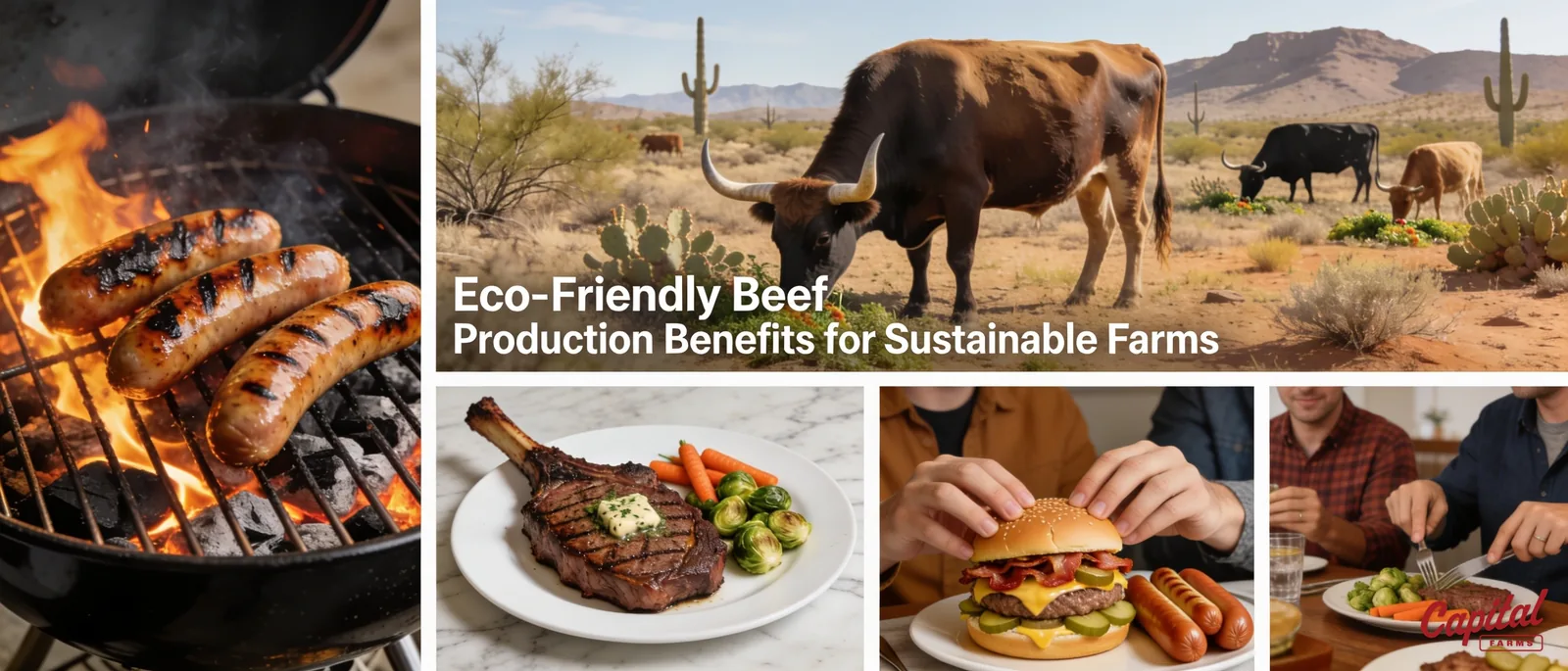
Eco-friendly beef production strengthens sustainable farming by restoring soil health, protecting sensitive ecosystems, and reducing reliance on artificial irrigation and fertilizers. Corriente cattle grazing rangelands near Wickenburg, AZ, for two years exemplify this model, converting desert land unsuitable for other breeds into productive, regenerating pasture while supporting long-term ranch viability and local economies.
Key Takeaways
- Regenerative grassfed beef farming restores soil health and actively combats climate change through sustainable agricultural practices.
- Grass-fed beef production reduces carbon footprint compared to conventional livestock farming methods significantly.
- Sustainable beef practices protect critical ecosystems including North America's great plains and Australian watersheds.
- Capital Farms Meats & Provisions raises premium Corriente beef using eco-friendly methods in Wickenburg, Arizona.
How Does Regenerative Grazing Protect Southwest Rangeland?
Regenerative grazing protects Southwest rangeland by matching cattle genetics to the land itself rather than forcing the land to accommodate the wrong breed. Corriente cattle graze the rangelands surrounding Wickenburg, Arizona, for two full years, feeding on native desert plants. No artificial irrigation and no synthetic fertilizers enter the equation. That absence matters: irrigation-dependent grazing systems drain aquifers already under stress across the Southwest. Fertilizer runoff degrades soil chemistry over time.
The Corriente breed's biology supports this approach. Descended from cattle brought to the Americas in the 1400s, the breed developed traits that make it tough, sustainable, and naturally resistant to disease. Those traits allow Corriente cattle to thrive where other breeds struggle or fail outright.
Why does breed selection matter for land regeneration?
Breed selection determines whether grazing land recovers or degrades under cattle pressure. Corriente cattle put marginal desert acreage to productive use, land unsuitable for many conventional beef breeds. Helping regenerate surrounding ecosystems as they grow strong and healthy.
Sustainably managed grazing programs can deliver measurable conservation outcomes:
- Reduced dependence on irrigated water sources
- Lower fertilizer and chemical inputs
- Productive use of otherwise marginal terrain
- Support for eco-friendly beef production benefits across arid rangeland systems
Ranchers weighing a transition toward regenerative practices should look closely at breed-land compatibility first. The right genetics change everything downstream.
Can Grain-Finishing Cut Beef's Carbon Footprint?
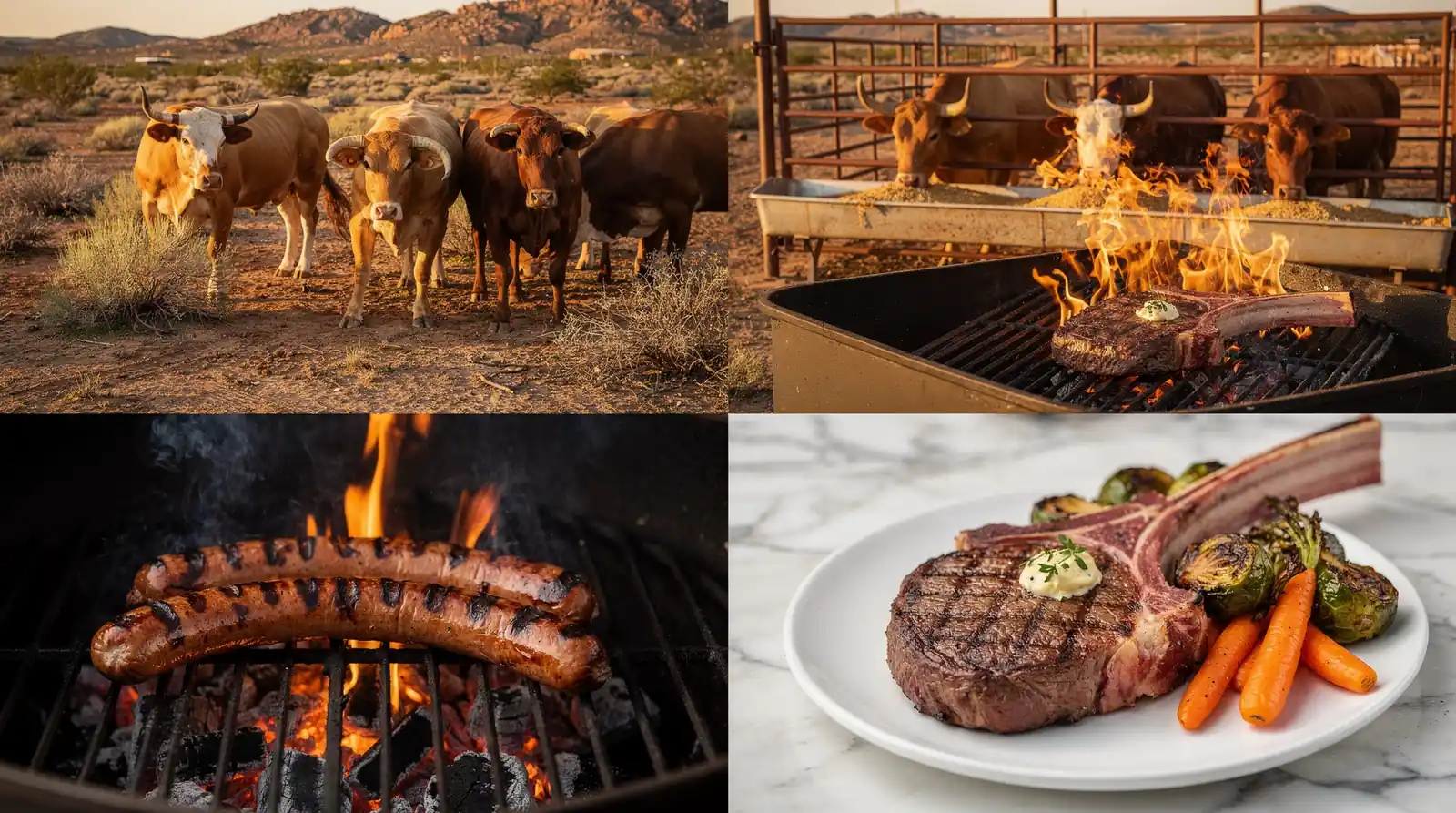
Grain-finishing lowers methane output compared to cattle raised on grass alone, according to animal science research. That matters for ranchers weighing environmental impact against product quality. Capital Farms' cattle graze on open rangeland first, then move to a 200-day grain-finishing period that builds tenderness and flavor without synthetic hormones. Growth happens on nature's schedule, not an accelerated one.
Does feedlot finishing really reduce agricultural emissions?
Research points to two combined factors: lower methane from grain-based diets and reduced land requirements in feedlot-type systems. Together, these findings have led many in the industry to argue that intensive finishing outperforms grass-only production on carbon footprint and food security grounds. For producers evaluating eco-friendly beef production benefits, this is a data point worth weighing seriously.
Ranchers considering a hybrid model can look at the tradeoffs this way:
| Factor | Grass-Only | Grass-Fed, Grain-Finished |
|---|---|---|
| Methane emissions | Higher, per research findings | Reduced, per animal science studies |
| Land requirement | Larger grazing footprint | Smaller, feedlot-supported finishing |
| Hormone use | Varies by operation | None, at Capital Farms |
Blending pasture-based grazing with a defined grain-finishing window offers a practical middle path. It supports flavor development while addressing emissions concerns that pure grass-fed systems face.

What Economic Value Does Sustainable Beef Deliver?
Sustainable beef production delivers value through premium positioning, local economic support, and measurable customer trust. Extended time on rangeland gives Corriente cattle marbling that rivals graded Choice or Prime beef, a trait that lets ranchers command stronger prices for a differentiated product. That marbling doesn't happen by accident. It results from cattle harvested at 48 months or older, far past the typical 18-month timeline, producing a deeper flavor and tender texture most commodity beef never reaches.
This longer production cycle changes the economics for ranchers willing to invest the time. Eco-Friendly beef production benefits extend beyond the pasture, too. Regenerative grassfed and pastured beef is typically raised by smaller operations, which keeps capital circulating in local farm economies rather than flowing to distant supply chains.
Does Quality Beef Actually Build Customer Loyalty?
Quality translates directly into repeat business and referrals. Consistent standards behind premium, slow-raised beef have earned a 4.9-star rating across 3.4K customer reviews, proof that flavor and texture differences register with buyers.
For ranchers weighing the transition, the value stacks up:
- Premium pricing tied to natural marbling and extended finishing
- Stronger local economic ties through smaller-scale operations
- Documented customer trust reflected in review data
- Product differentiation from standard 18-month beef
Eco-friendly beef production represents more than a farming practice—it embodies a commitment to environmental stewardship and agricultural integrity. Capital Farms demonstrates that sustainable ranching, rooted in time-honored traditions and refined through modern standards, delivers exceptional quality while regenerating the land. By raising Corriente cattle on desert rangelands without artificial inputs and finishing them naturally, we prove that premium beef and environmental responsibility advance together. This approach honors both the heritage of ranching and the future of sustainable agriculture.
FAQ
What makes Corriente cattle suited to eco-friendly beef production?
Corriente cattle descend from breeds brought to the Americas in the 1400s, giving them toughness, sustainability, and natural disease resistance. These traits let them thrive on Wickenburg, Arizona rangeland without artificial irrigation or synthetic fertilizers.
How does regenerative grazing benefit desert rangeland?
Regenerative grazing matches cattle genetics to the land, letting Corriente cattle convert marginal desert acreage into productive, regenerating pasture. This process reduces dependence on irrigated water and lowers fertilizer and chemical inputs.
Why does Capital Farms grain-finish cattle after grazing?
Capital Farms grazes cattle on open rangeland first, then applies a 200-day grain-finishing period that builds tenderness and flavor without synthetic hormones. Grain-finishing also lowers methane output compared to grass-only raising.