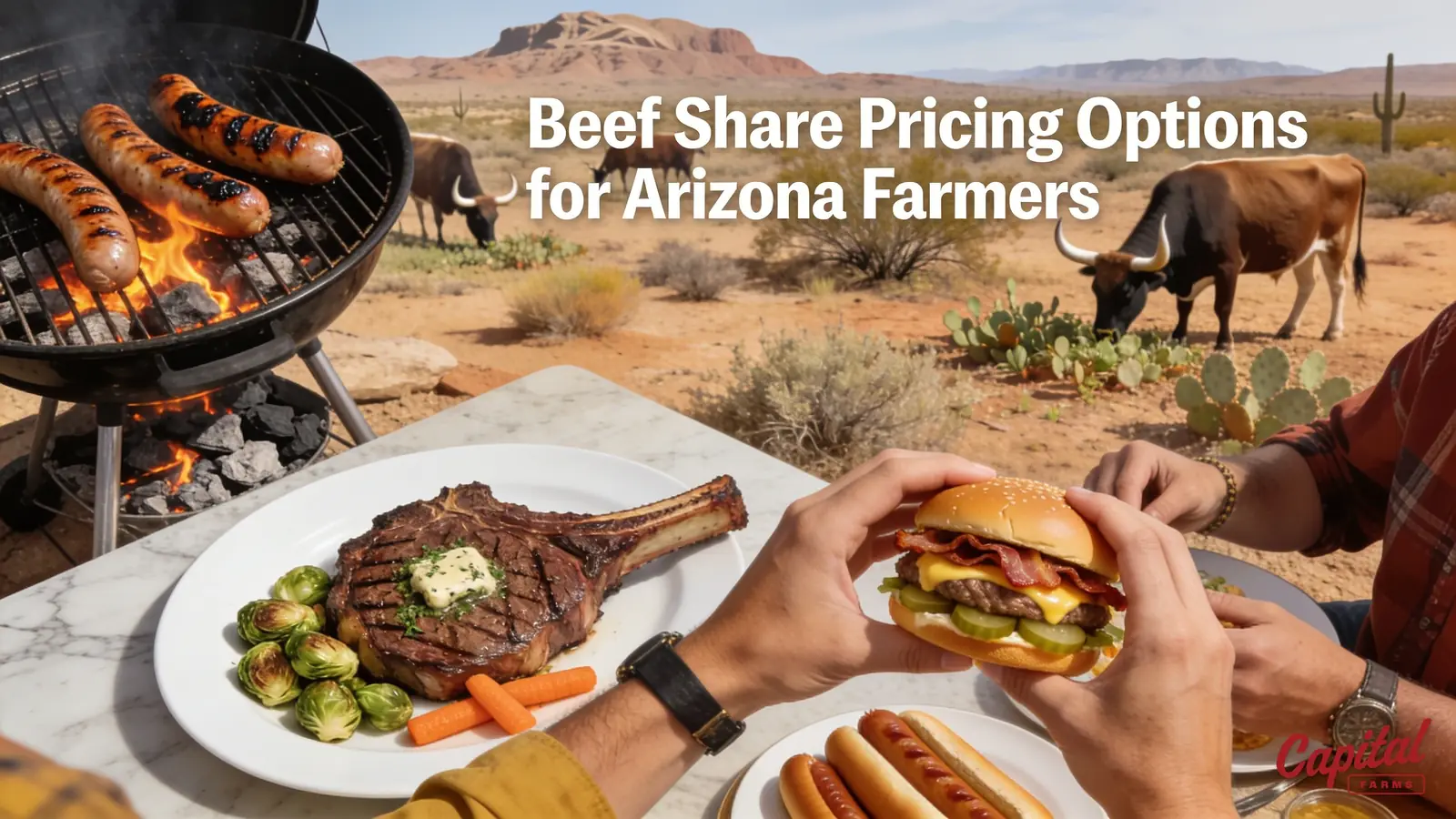
Beef Share Pricing Options for Arizona Farmers
Beef Share Pricing Options for Arizona Farmers
By Capital Farms Meats & Provisions Editorial Team · Updated 2026-07-28
When it comes to Beef Share Pricing Options, capital Farms Meats & Provisions in Wickenburg, Arizona, prices beef by cut and volume rather than traditional herd shares, with NY Strip Steak starting at $23.00 and Sirloin Steak at $22.00, plus free shipping on orders exceeding $250 across 13 states.
Beef Share Pricing: Whole beef runs pricing varies–pricing varies (about $8.93/lb), half beef pricing varies–pricing varies (~$9.29/lb), and quarter beef pricing varies–pricing varies based on estimated hanging weights of 210–1,000 lbs depending on share size selected.
Beef share pricing structures for Arizona ranchers depend on cut selection, hanging weight, and processing terms rather than a fixed formula. Arizona's cattle industry generated $891 million in cash receipts, per USDA data, showing strong demand that supports direct-to-consumer share pricing. Farmers building share programs should benchmark local processing costs and consult Capital Farms Meats & Provisions for guidance.
Key Takeaways
Capital Farms Meats & Provisions in Wickenburg offers whole beef shares at $14.93 per pound of meat.
Whole beef shares yield 300 pounds of meat from 550 pound hanging weights for $4800-$6000.
Half beef shares provide 150 pounds of meat requiring 10-14 cubic feet of freezer space.
Arizona beef producers generated $891 million in cash receipts from 100% grass-fed, hormone-free cattle operations.
What Do You Need Before Setting Beef Share Pricing?
Accurate hanging weight data and a clear picture of portion sizes come first. Arizona ranchers building beef share pricing options need to know how whole, half, quarter, and eighth beef portions differ in weight and yield before quoting a single dollar figure. Skipping this step invites underpricing, lost margin, and confused customers at pickup.
How Do Portion Sizes Affect Pricing?
Arizona beef share programs are commonly divided into four standard portions, each carrying its own hanging weight range and price-per-pound structure. Smaller shares generally cost more per pound than larger ones, since processing costs and packaging spread across less meat.
Portion |
Hanging Weight |
Price Trend |
|---|---|---|
Whole beef |
550–1,000 lbs |
Lowest price per pound |
Half beef |
225–500 lbs |
Moderate price per pound |
Quarter beef |
110–250 lbs |
Higher price per pound |
Eighth beef |
50–125 lbs |
Highest price per pound |
Does the Local Market Matter?
Arizona's cattle economy carries real weight behind these numbers. The state's beef industry generated $891 million in cash receipts despite ongoing drought pressure, according to recent USDA figures. That resilience signals steady consumer demand for direct beef purchases across Arizona ranch operations.
Ranchers should gather hanging weight estimates, processing costs, and regional demand data before publishing rates. Capital Farms, a small Wickenburg-based beef business with eight employees, applies this same groundwork when serving Arizona customers.
How Do You Structure Beef Share Pricing Options Step by Step?
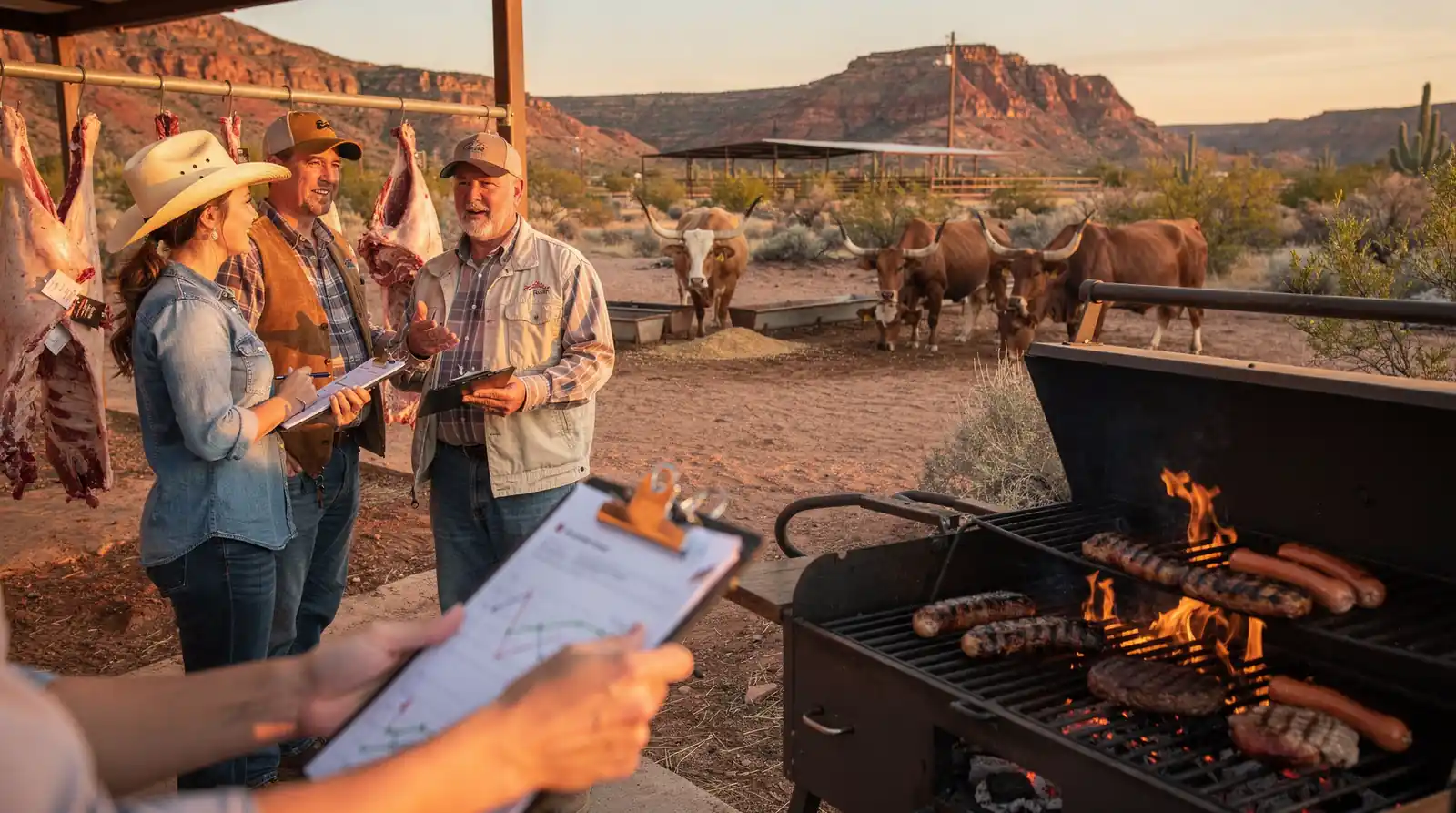
Arizona ranchers build sound beef share pricing options by working backward from hanging weight, not by guessing at a apartment rate. Skipping this math costs money on every share sold, since underpriced cuts erase margin before a single box ships. A step-by-step approach keeps pricing consistent across whole, half, and quarter shares.
Estimate the whole beef share first. Hanging weight typically runs 850 to 1,000 pounds, yielding 400 to 700 pounds of meat and a final all-in price between pricing varies and pricing varies, roughly $8.93 per pound.
Calculate the half beef share separately. Hanging weight falls between 425 and 500 pounds, producing 200 to 350 pounds of meat priced from pricing varies, near $9.29 per pound.
Price the quarter beef share on its own terms. Hanging weight lands between 210 and 250 pounds, with 100 to 175 pounds of meat and a final price of pricing varies closer to $10.64 per pound.
Benchmark cut value against retail. Comparing share pricing to premium items like Ribeye Steak starting from $31.00 shows customers the savings built into buying in bulk.
Account for byproduct value. Rendered tallow sold in a 14 oz jar for $11.99 adds revenue that can offset overall share pricing.
Share Size |
Hanging Weight |
Price Range |
Rough $/lb |
|---|---|---|---|
Whole |
850–1,000 lbs |
pricing varies–pricing varies |
$8.93 |
Half |
425–500 lbs |
pricing varies–pricing varies |
$9.29 |
Quarter |
210–250 lbs |
pricing varies–pricing varies |
$10.64 |
Why Does Price Per Pound Rise for Smaller Shares?
Smaller shares carry a higher price per pound because processing costs get spread across fewer pounds of meat. A quarter share at $10.64 per pound still delivers value compared to buying premium cuts individually at retail rates.
What Mistakes Should Arizona Ranchers Avoid With Pricing?
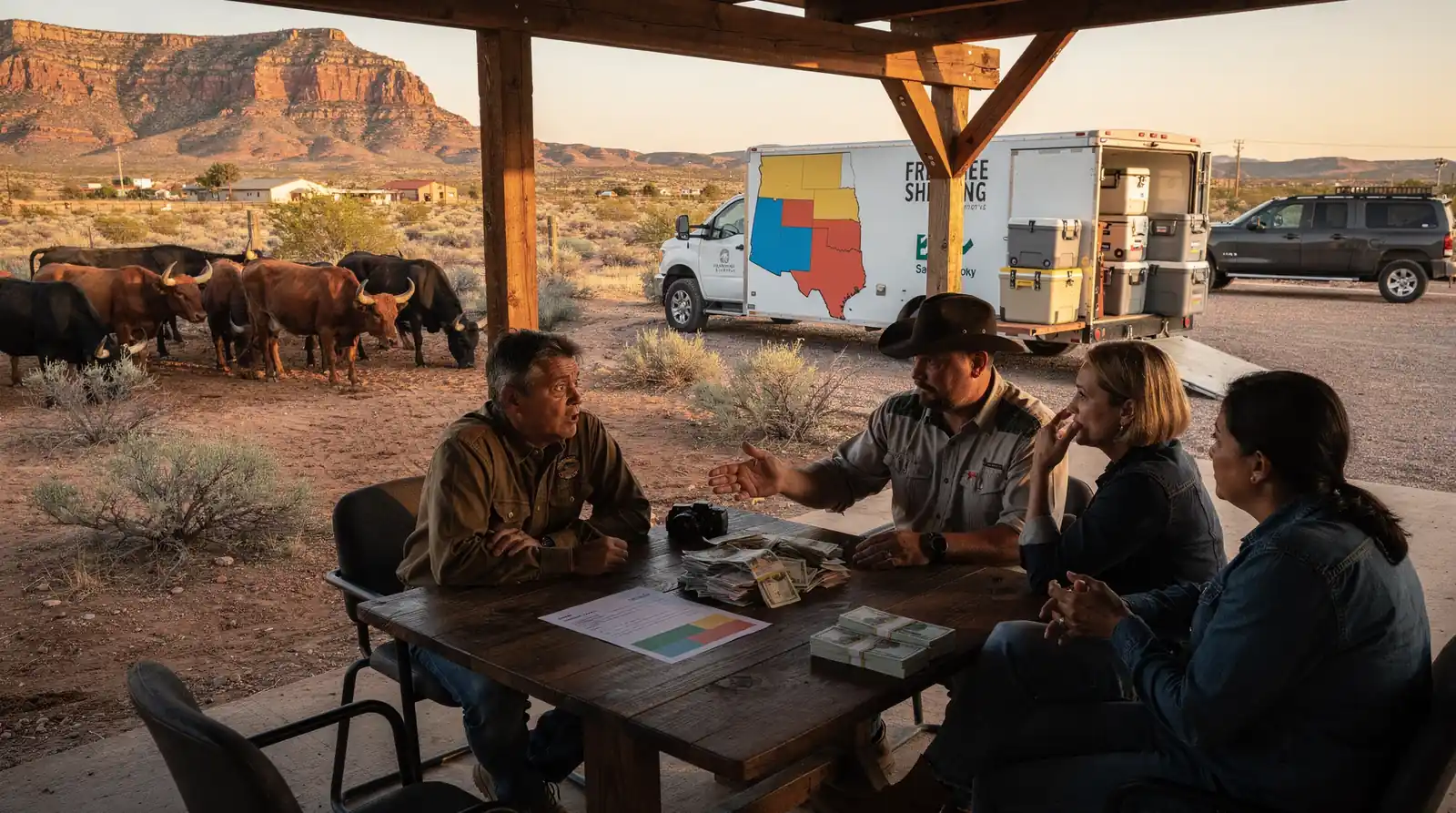
Four pricing mistakes cost Arizona ranchers repeat business and referrals. Blurring the line between a deposit and the final balance confuses buyers at pickup. Clear Beef Share Pricing Options separate the deposit from the remaining balance, which should be invoiced and paid before pickup day. Ranchers who skip this step often field frustrated calls the morning of delivery.
Ignoring shipping thresholds is another costly error. Buyers in remote Arizona counties abandon orders when shipping costs outweigh savings. Offering free shipping on qualifying orders keeps distant customers engaged.
Underpricing to compete on cost alone weakens long-term trust. Quality and consistency, not discount pricing, build the kind of reputation reflected in strong customer ratings built over thousands of reviews.
Should Pricing Mention How the Cattle Are Raised?
Yes. Buyers pay more when they understand the story behind the beef. Skipping mentions of open-range grazing on native Arizona grasses leaves money on the table compared to ranchers who lead with that narrative.
Capital Farms remains committed to delivering premium Corriente beef that reflects both agricultural tradition and modern quality standards. Our approach to sourcing and finishing ensures that Arizona farmers and beef enthusiasts alike receive products distinguished by natural marbling, tenderness, and authentic flavor. By maintaining rigorous standards from rangeland to table, we continue to demonstrate that sustainable ranching practices and exceptional beef quality are not competing interests but complementary commitments to excellence.
FAQ
How much does a whole beef share cost in Arizona?
Whole beef shares cost pricing varies–pricing varies, based on a hanging weight of 850–1,000 lbs, which works out to about $8.93 per pound.
Why do smaller beef share portions cost more per pound?
Smaller shares like quarters and eighths carry higher per-pound prices because processing costs. Packaging spread across less meat compared to whole or half shares.
What information do ranchers need before setting beef share pricing?
Ranchers need accurate hanging weight data, portion yield differences, and regional demand figures. Arizona's cattle industry generated $891 million in cash receipts supporting strong direct-to-consumer demand.