
whole cow
Buy Whole Beef Online: The Ultimate Guide to Whole Cow Shares from Capital Farms

Buying a whole cow turns bulk purchasing into a reliable way to stock your freezer with premium meat, lower your per‑pound cost, and simplify meal planning for months at a time. This guide walks you through what a whole cow share is, how pricing and processing work, which cuts you’ll receive, how to size your freezer, and what to expect from regeneratively raised Corriente beef compared with conventional options. You’ll learn how to estimate hanging weight versus take‑home weight, plan freezer capacity, and make smart decisions about custom butchering and portioning. The article covers six practical areas: why a whole‑cow share delivers value; a cuts list paired with cooking recommendations; step‑by‑step pricing and processing examples; freezer sizing and packing tips; the benefits of regenerative raising and Corriente breed traits; and common ordering and pickup questions. Throughout, we use terms like whole beef share, hanging weight, take‑home weight, Corriente beef, and regenerative ranching so you can compare options and plan your bulk purchase with confidence.
Why Should You Buy a Whole Cow Share?
A whole cow share means you buy the entire carcass and receive a complete assortment of cuts. That approach stretches your dollar by removing retail markups, gives you control over cutting and packaging, and provides clear traceability from ranch to freezer. Buying whole also makes meal rotation and freezer inventory predictable—handy for families who want fewer trips to the store and steadier per‑pound costs. When you buy direct, you can confirm breed, raising practices, and finishing methods—information that matters if you care about ethics, flavor, or animal welfare. Those benefits are the starting point for understanding how the cost savings actually add up.
Most buyers choose a whole cow for three main reasons:
- Lower cost per edible pound versus buying steaks and roasts at retail.
- Control over butchering, portion sizes, and packaging to match household needs.
- Traceability and higher confidence in quality when buying directly from a regenerative ranch.
Those advantages make whole‑cow purchases especially attractive for larger households and cooks who value consistency. Next, we’ll break down how those savings typically show up in numbers.
What Are the Cost Savings of Buying Bulk Freezer Beef?

Buying a whole cow generally lowers your average cost per edible pound because processor and retail margins are spread across the entire carcass. Here’s a simple example: a 1,000 lb hanging weight with a 60% take‑home yield → roughly 600 lb take‑home; if total cost (including processing) is $2,400, your effective cost is $4.00 per take‑home pound. That number will shift based on processing choices, steak thickness, trimming level, packaging, and shipping or pickup fees. Because those variables differ by buyer and processor, ask for an itemized breakdown so you can compare true per‑pound costs before you commit.
Common variables that change the final per‑pound price include:
- Processor selection and aging time.
- Packaging style (vacuum sealing vs. bulk) and portion sizes.
- Custom cut requests and extra trimming.
Knowing these factors helps you compare quotes and estimate your real cost for a whole beef share.
How Does Capital Farms Ensure Premium Quality Corriente Beef?
Capital Farms raises Corriente cattle in Arizona using regenerative practices, longer raising periods (48 months or more), and a grain‑finishing stage to boost flavor and tenderness. Those elements—breed, extended raising, and finishing—are the ranch’s core quality claims: Corriente contributes a specific eating profile, longer time on pasture deepens flavor, and grain finishing enhances marbling. Capital Farms sells directly to consumers with half and whole cow shares to offer traceability and consistent quality, and the ranch backs its product with a satisfaction approach. These production choices help buyers decide whether the breed, raising timeline, and finishing align with their taste and values.
With that context, let’s look at exactly which cuts arrive when you buy a whole cow share.
What Cuts Are Included in a Whole Cow Meat Share?
A whole cow share contains the full range of primal and subprimal cuts from head to tail—typically rib, loin, sirloin, round, chuck, brisket, short ribs, flank, skirt, ground beef, and bones for stock. Knowing each cut’s origin and best cooking uses helps you request the right packages from your processor and plan meals. The table below pairs common cuts with typical yields and suggested cooking methods so you can decide what to custom‑order and what to use first. After the table, we explain how customization affects yields and packaging.
The core cuts, their origin, and primary uses are:
| Cut | Typical Yield per Whole Cow (approx.) | Suggested Cooking Method / Use |
|---|---|---|
| Ribeye / Prime Rib | 8–14 lb total | Pan‑seared steaks, oven‑roasted prime rib |
| Strip / NY Strip | 6–12 lb total | Grilling, broiling, high‑heat searing |
| Tenderloin / Filet | 4–6 lb total | Quick roasting, pan‑searing, special‑occasion steaks |
| Chuck (roasts & stew) | 80–120 lb total | Braising, slow roast, ground beef |
| Round (roasts & steaks) | 80–130 lb total | Roasts, slow‑cooking, thin‑cut steaks |
| Brisket & Short Ribs | 30–80 lb total | Smoking, braising, long, low‑heat cooking |
| Flank & Skirt | 10–20 lb total | Grilling, marinating, fajitas |
| Ground & Trimmings | 150–300 lb total | Burgers, meatballs, sauces |
| Bones | 20–60 lb total | Stocks, soups, braises |
Use this mapping to prioritize which packages to request and to plan meals around tougher cuts that reward slow cooking. Next, we’ll cover how customization affects yield and packaging choices.
Which Beef Cuts Come from a Whole Cow?
A whole cow yields all primals and many subprimals that your processor can portion into steaks, roasts, and ground meat. Steaks come from the rib and loin; roasts and stew meat come from chuck and round; brisket and short ribs are best for long, slow cooks. Ground beef is made from trimmings across the carcass and typically represents the largest share of take‑home pounds. Bones and shanks are perfect for stocks. How you choose to package—vacuum‑sealed single portions versus family packs—will influence how you use the meat and how it fits in your freezer.
Can You Customize Your Whole Cow Order?
Customization is one of the biggest benefits of buying whole. Most processors let you specify steak thickness, roast portion sizes, grind percentages, and packaging styles so your order matches how you cook. Common requests include:
- 1‑inch versus 1.5‑inch steaks
- Cutting roasts into two or four servings
- Vacuum‑sealed single‑portion packs versus larger family packs
Custom choices can slightly change take‑home weight through extra trimming or deboning, and some processors charge for specialty packaging. Ask about constraints and fees up front so you can estimate portions and plan freezer shelf space efficiently.
How Is Whole Cow Pricing and Processing Structured?
Pricing for whole cows usually includes the animal cost (priced by live or hanging weight), processing fees (slaughter, cut‑and‑wrap, aging), and optional logistics like delivery or storage. The key distinction to understand is hanging weight versus take‑home weight: hanging weight is the carcass weight after slaughter and initial trimming; take‑home weight is the packaged, edible meat after aging, cutting, trimming, and packaging. Transparent, itemized quotes that separate carcass cost from processor fees make it easier to estimate your final per‑pound expense. The table below outlines typical price components, what they cover, and example ranges so you can model your expected outlay.
| Price Component | What It Covers | Example / Range |
|---|---|---|
| Carcass / Hanging Price | Cost of animal expressed as hanging weight | Varies by supplier; sample calculation uses $2,400 total purchase |
| Processing Fee | Slaughter, inspection, cutting, vacuum sealing | $0.50–$1.50 per lb processed (varies by processor) |
| Aging & Trimming | Dry or wet aging time and trimming choices | May be bundled or itemized; affects yield |
| Packaging | Vacuum seal, tray pack, portion size | Per‑package fee or included in processor rate |
| Delivery / Pickup | Transport to customer or local pickup logistics | May be flat fee or free if local pickup |
This breakdown lets you plug in a hanging weight and local processor rates to estimate a final per‑pound cost. For example, a half‑cow price advertised at $2,199 can be doubled and adjusted for processor fees to approximate a whole‑cow cost, though exact totals depend on hanging weight and cut choices. Capital Farms lists half and whole share options in its freezer beef collection to simplify budgeting and ordering.
What Is the Difference Between Hanging Weight and Take‑Home Weight?
Hanging weight is the carcass weight right after slaughter and primary trimming. Take‑home weight is what you get back—aged, cut, trimmed, and packaged. Typical conversion ratios run roughly 55% to 65% take‑home of hanging weight, depending on trimming level, bone‑in vs. boneless choices, and aging loss. Quick formula: Take‑home pounds ≈ Hanging weight × Yield percentage (for example, 0.60). So a 1,100 lb hanging carcass at 60% yield would give about 660 lb take‑home; divide total cost by 660 to find the effective cost per edible pound. Understanding this conversion helps you compare advertised hanging‑weight prices and calculate true per‑pound costs.
Those weight distinctions feed directly into the logistics that turn a raised animal into sealed packages in your freezer.
What Are the Steps from Ranch to Your Freezer?
The ranch‑to‑freezer sequence is straightforward: raise and finish the animal on the ranch, schedule slaughter and inspection, age the carcass, have it cut and packaged at a processor, then pick up or receive delivery. Timelines vary—processors need lead time and aging choices (wet vs. dry) affect readiness—so expect a multi‑week timeline from booking to pickup in many cases. Responsibilities split between the ranch (animal care and transport to the processor) and the processor (slaughter, aging, cutting, packaging); you handle payment, cut instructions, and pickup or delivery arrangements. Clear, timely cut instructions prevent surprises when tallying take‑home pounds and costs.
- Choose a ranch or provider and select a whole or half share.
- Schedule a processor and confirm cutting and packaging specifications.
- Transport the animal to the processor and complete any deposit or payment.
- Pick up or arrange delivery once processing and aging are finished.
Planning ahead and communicating clearly ensures your order comes back the way you expect.
How Much Freezer Space Do You Need for a Whole Cow?
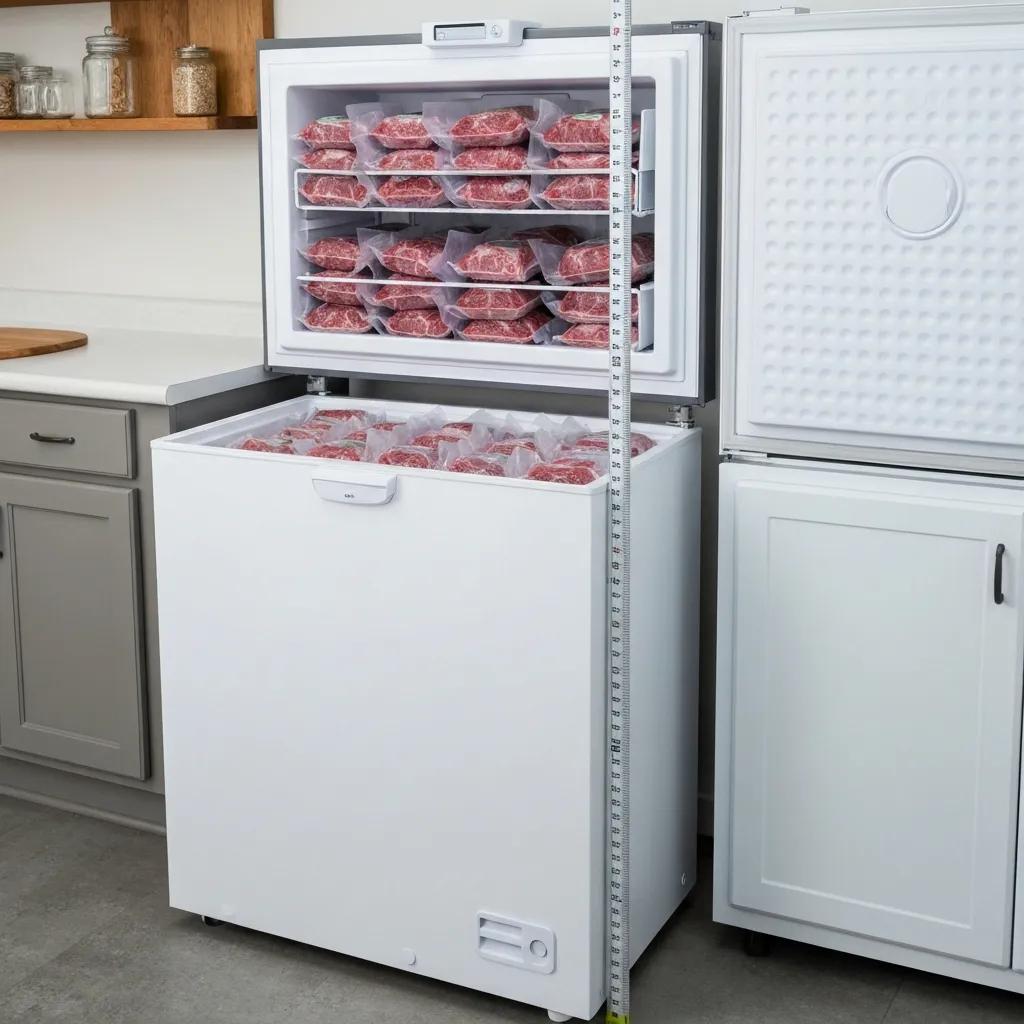
Estimate freezer space from expected take‑home pounds: most whole cows yield roughly 500 to 900+ take‑home pounds depending on animal size and yield percentage. A good rule of thumb is that 1 cubic foot holds about 30–35 pounds of vacuum‑sealed beef when packed efficiently—so 600 lb needs roughly 18–20 cubic feet. The table below links common freezer sizes to estimated pound capacities, helping you pick a freezer that fits your expected take‑home. After the table we offer packing and organization tips to maximize space and preserve quality.
| Freezer Type / Size | Approx. Cubic Feet | Estimated Capacity (pounds) / Packing Tips |
|---|---|---|
| Small chest (5–7 cu ft) | 5–7 | 150–245 lb; best for supplemental storage, not whole cow |
| Mid-size chest (12–16 cu ft) | 12–16 | 360–560 lb; may hold a half cow with careful packing |
| Large chest (18–25 cu ft) | 18–25 | 540–875 lb; suitable for most whole‑cow take‑home ranges |
| Upright (14–20 cu ft) | 14–20 | 420–700 lb; better organization, slightly less efficient packing |
A large chest freezer or a roomy upright with vacuum‑sealed packs will comfortably store a whole cow if you plan the layout. Next, we cover meal‑planning and packing strategies to reduce clutter and waste.
What Are the Recommended Freezer Sizes for Bulk Beef?
For typical whole‑cow take‑home yields, an 18–25 cubic‑foot chest freezer is the best balance between capacity and cost, holding about 540–875 pounds when packed tightly. Mid‑size freezers (12–16 cu ft) can work for half shares or smaller whole cows but require careful stacking. Upright freezers make organization easier for frequent access but usually sacrifice some packing efficiency. When choosing a unit, consider energy use, door seal quality, and manual vs. automatic defrost for long‑term storage.
Smarter portioning and packing extend freezer usability and reduce wasted space.
How Can You Maximize Your Whole Cow with Meal Planning?
Get the most from a whole cow by matching package sizes to your meal patterns, rotating perishable cuts first, and keeping a balance of quick steaks and long‑cook roasts. Practical strategies include:
- Portion single‑serving steaks for weeknight dinners.
- Bundle slow‑cook roasts for monthly meal prep.
- Divide ground beef into 1–2 pound packs for fast thawing and use in casseroles or burgers.
Freezing and thawing best practices: label each package with the cut and date, freeze flat for easier stacking, and thaw large roasts in the refrigerator 24–48 hours ahead to preserve texture and safety. These routines reduce waste and help you enjoy every cut.
Sample rotation plan:
- Weekly: two steak dinners, two ground‑beef nights, one roast or stew.
- Monthly: batch soups, chilis, and meal kits for quick reheating.
- Seasonal: save brisket and short ribs for cold‑weather slow cooks.
These habits make bulk buying practical and convenient.
What Are the Benefits of Buying Regeneratively Raised Whole Cow Beef?
Regenerative ranching emphasizes soil health, biodiversity, and managed grazing to improve ecosystem function while raising livestock. Healthier soils and diverse pastures support better forage and resilient animals, which can influence eating quality over time. Many consumers link regenerative practices with ethical land stewardship and potential flavor benefits. Regenerative systems also aim to deliver ecosystem services such as carbon sequestration and improved water retention—factors that appeal to buyers who weigh environmental impact alongside taste and price.
Capital Farms frames its Corriente beef inside this regenerative approach: longer raising periods (48 months or more), grain‑finishing for flavor and tenderness, and claims of hormone‑free and mRNA‑free production as part of its product attributes. These production details help buyers who prioritize breed characteristics and transparent rearing practices—consider ordering a whole or half share directly from the ranch if traceability and farm practices matter to you.
How Does Regenerative Ranching Improve Beef Quality and Environment?
Regenerative practices improve soil structure, boost biodiversity, and build ecosystem resilience through managed grazing and diverse plantings. Those farm improvements can translate into healthier forage and stronger animal condition over longer raising periods, potentially affecting fat distribution and flavor in the meat. From a practical standpoint, regenerative methods align ethical land management with consumer preferences for sustainably raised food, though results depend on specific on‑farm implementation. Understanding these links helps you weigh environmental benefits alongside taste and cost.
These ecological considerations tie directly into breed selection and finishing choices that shape eating quality.
Why Choose Hormone‑Free, mRNA‑Free Corriente Beef?
Claims like hormone‑free and mRNA‑free reflect the ranch’s production choices and are meant to signal minimal intervention during raising. Corriente, combined with extended pasture time (48+ months) and grain finishing, is presented as producing a distinctive flavor and good tenderness. Choosing Corriente raised under these practices fits buyers who prefer breed‑specific flavor, transparent rearing, and limited interventions—factors that often drive repeat purchases and interest in whole or half shares directly from a ranch with clear practices.
What Are the Most Common Questions About Buying a Whole Cow?
Prospective buyers typically ask about total take‑home pounds, whether a whole cow is cost‑effective for their household, ordering logistics, pickup or delivery options, and storage timelines. Short, practical answers help you decide quickly: expected take‑home ranges, the situations where whole purchases make the most sense (large households, frequent entertainers), and what to expect when coordinating cuts and pickup. Below are focused FAQs that address those common decision points; transactional details reference buying directly from a ranch or the freezer beef collection for current scheduling and options.
- How much meat do you get from a whole cow? — Typical take‑home ranges commonly fall between 500–900+ pounds depending on hanging weight and yield choices; final totals depend on trimming and cut preferences.
- Is buying a whole cow worth it? — Whole cows make sense for households consuming large quantities of beef, shoppers seeking per‑pound savings, or buyers who want custom cuts and traceability; smaller households may prefer half, quarter, or 1/8 shares.
- How do I order and pay? — Orders are placed through the ranch or provider offering whole/half share options; expect to provide cut instructions and pay a deposit, with final payment due before pickup or delivery.
- Where do I pick up or arrange shipping? — Pickup is usually at the processor or a ranch‑designated point; shipping may be available via cold‑chain transport depending on provider logistics.
How Much Meat Do You Get from a Whole Cow?
Typical take‑home pounds from a whole cow most often range from about 500 to 900+ pounds, depending on hanging weight, trimming level, and how many cuts are bone‑in versus boneless. Variables include the animal’s live and hanging weights, trimming preferences, aging loss, and whether roasts are deboned.
To estimate take‑home pounds, request the hanging‑weight figure and apply a yield percentage—commonly 55%–65%. Those numbers let you plan freezer space and calculate the effective per‑pound cost for meal planning.
Is Buying a Whole Cow Worth It Compared to Other Options?
Buying a whole cow is best for large households, frequent entertainers, or anyone who plans to stock the freezer long‑term and wants custom butchering. It’s less practical for infrequent beef eaters or those without freezer space. Pros: lower per‑pound cost, control over cuts, and steady supply. Cons: larger upfront cost, significant freezer needs, and coordination for processing and pickup. For many buyers, a half or quarter share offers a practical middle ground—real savings with fewer logistical demands—while a 1/8 share suits smaller households wanting some bulk benefits. Match share size to your household’s consumption and storage capacity.
These points help you choose a share size and processor arrangement that fit your needs.
Ordering and Pickup / Shipping (Transactional FAQs)
Ordering and pickup procedures vary by provider: most ranches and freezer‑beef sellers take orders by phone or an online form and require a deposit or full payment to reserve processor time. Pickup commonly happens at the processor or a designated local point; some providers offer cold‑chain shipping when available. If you plan to order a whole or half cow, confirm payment terms, processor selection, packaging options, and whether the ranch coordinates delivery or requires customer pickup. Capital Farms lists ordering and pickup details as part of its freezer‑beef product group—check with the ranch for current scheduling and available share sizes.
These answers wrap up the FAQ and outline the logistics you should confirm before purchasing a whole beef share.
Frequently Asked Questions
What is the best way to store a whole cow share in my freezer?
Vacuum‑seal individual cuts to prevent freezer burn and preserve quality. Group similar cuts—steaks, roasts, ground beef—so you can find what you need quickly. Label each package with the cut and date. A large chest freezer offers the best packing efficiency and insulation, while an upright is handy for organization. Keep the freezer at 0°F (‑18°C) or colder for optimal preservation.
How long can I keep beef from a whole cow share in the freezer?
Frozen beef keeps well for months: vacuum‑sealed roasts and steaks can retain quality for up to a year, while ground beef is best used within 3–4 months for peak texture and flavor. Packaging quality and freezer temperature matter—always check for freezer burn or off odors before cooking.
What are the environmental benefits of buying regeneratively raised beef?
Buying regeneratively raised beef supports practices that improve soil health, enhance biodiversity, and build ecosystem resilience. Managed grazing and diverse forage can help sequester carbon and improve water retention. By choosing regenerative ranching, consumers back ethical land management and systems that aim for long‑term sustainability—benefits that often resonate with environmentally conscious buyers.
How can I ensure the quality of the beef I receive?
Choose a ranch with transparent, consistent practices and clear product information. Look for producer claims about regenerative practices and hormone‑free handling, and ask about aging and processing methods. Communicate your cut and packaging preferences clearly when ordering, and verify processing timelines so you know what to expect on pickup day.
What should I consider when planning meals with a whole cow share?
Plan around the variety of cuts you’ll receive: save quick‑cooking steaks for weeknights and schedule slow‑cooking roasts for weekends. Portion ground beef into convenient packs and label everything with dates. Rotate perishable items to the front of the freezer and use seasonal recipes—this approach ensures you get through the meat before quality declines.
Can I share a whole cow share with friends or family?
Yes—splitting a whole cow with friends or family is a practical way to reduce cost and storage burden. Coordinate processing instructions and packaging preferences ahead of time so everyone gets the portions they want. Sharing also lets you enjoy a wider range of cuts while keeping individual freezer needs manageable.
Conclusion
Buying a whole cow share delivers real savings, custom butchering, and direct traceability to a regenerative ranch. It’s a smart choice if you want consistent quality, predictable costs, and a freezer stocked for months. With a clear understanding of yields, processing, and freezer needs, you can choose the share size and packing options that fit your household and values. Explore your options today—investing in a whole or half share brings premium Corriente beef to your table while supporting sustainable ranching.